
How Each Rate Structure Works
When a lender quotes you an interest rate on an auto loan, that rate can be structured in one of two ways: fixed or variable. Understanding the mechanics of each helps you evaluate what you are actually agreeing to — not just the number on the contract. For a broader look at the components of an auto loan, see our guide to auto loan anatomy.
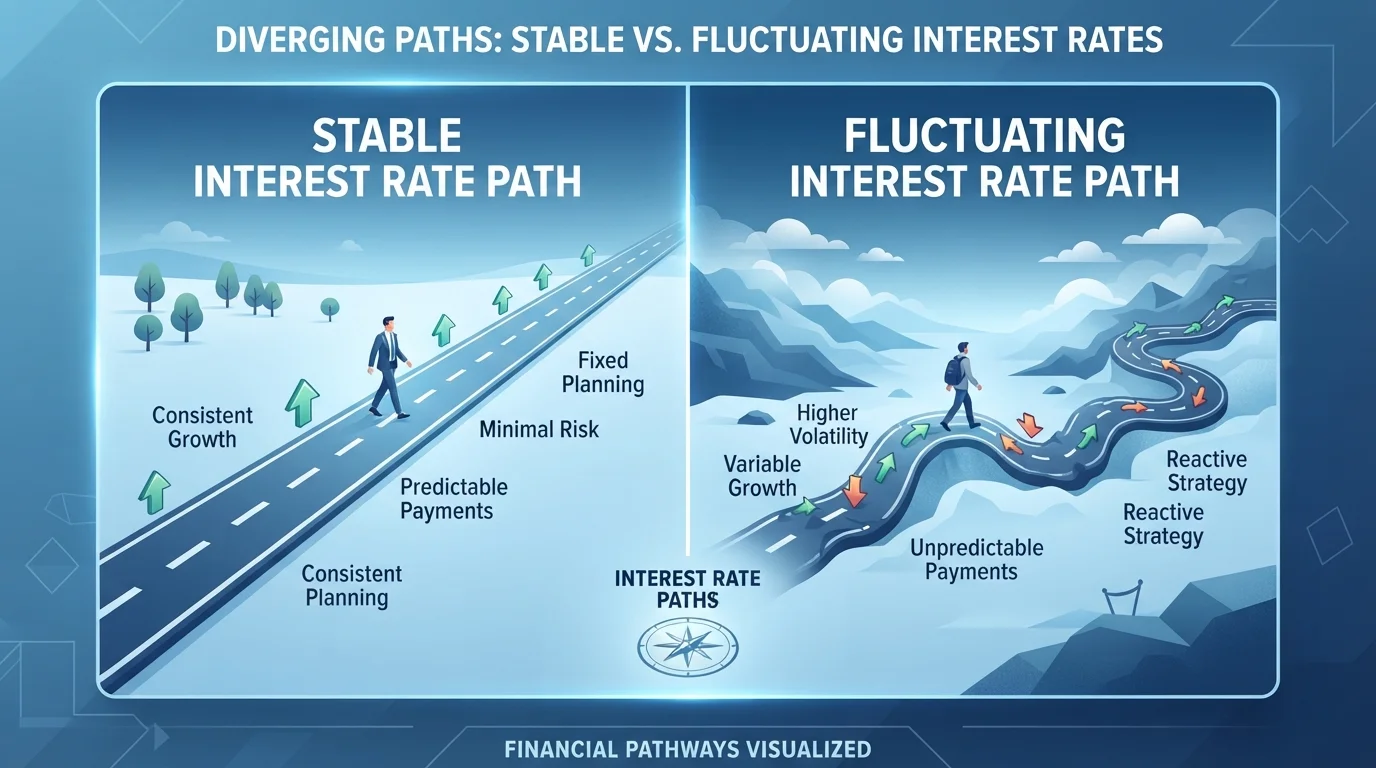
Fixed rate: The interest rate is set at origination and does not change for the life of the loan. Whether you are in month one or month 60, the rate applied to your outstanding principal remains identical. This means your monthly payment amount stays constant, and you can calculate the total interest cost before signing.
Variable rate: The interest rate is tied to a benchmark index — commonly the prime rate or SOFR (Secured Overnight Financing Rate) — plus a fixed margin set by the lender. As the index moves up or down, your rate adjusts accordingly, which can change your monthly payment or the total interest you pay over time.
| Criterion | Fixed Rate | Variable Rate |
|---|---|---|
| Rate stability | Locked at origination | Adjusts with benchmark index |
| Payment predictability | Same every month | Can change over time |
| Upside if rates fall | None (requires refinance) | Payments may decrease |
| Downside if rates rise | Protected | Payments may increase |
| Ease of comparison shopping | Straightforward — APR is fixed | Complex — APR based on current index |
| Prevalence in US auto market | Very common | Less common |
Variable-rate auto loans are notably less common in the US market than variable-rate mortgages or credit cards. Many lenders focus primarily on fixed-rate auto products, but variable-rate options do appear, particularly through certain credit unions and specialty finance companies.
Risk and Cost Considerations
Neither structure is inherently cheaper — actual cost depends on where rates are at origination, how long you carry the loan, and how the benchmark index moves over that period.
~85%
Share of US auto loans with fixed rates
Industry estimates consistently show fixed-rate structures dominate US auto lending, reflecting borrower preference for payment certainty.
48–72 months
Typical auto loan terms in the US
Longer terms increase the window over which a variable rate can shift, amplifying both potential benefit and risk for borrowers.
With a fixed rate, you accept the rate available at the time you borrow. If market rates fall significantly after you sign, you are still paying the original rate unless you refinance. On the other hand, if rates rise, your cost is insulated. The tradeoff is certainty: you give up potential upside (lower rates) in exchange for protection against downside (higher rates).
With a variable rate, your payments can decrease if the benchmark index drops — but they can also increase if it rises. For a loan with a 60- or 72-month term, meaningful rate swings are plausible. Lenders typically disclose a rate cap or adjustment ceiling, but borrowers should read that language carefully. This is explored further in our article on how rate environments affect auto financing decisions.
It is also worth distinguishing rate structure from interest calculation method. A fixed rate tells you the rate won't change; it does not tell you whether interest accrues on a simple or precomputed basis. Those are separate dimensions of loan cost, covered in our comparison of simple vs. precomputed interest.
Refinancing Can Change Your Rate Structure
If you take a variable-rate loan and later want to lock in a fixed rate — or vice versa — refinancing is one option. However, refinancing involves a new loan origination, which may include fees, a hard credit inquiry, and a reset of your loan term. Weigh these costs against the benefit of the rate change. Consult a licensed financial professional before refinancing.
Evaluating Rate Structures When Shopping for a Loan
When comparing loan offers, the APR is your most useful baseline — it incorporates the interest rate and most lender fees into a single annualized figure. For a fixed-rate loan, the APR quoted is stable and directly comparable across lenders. For a variable-rate loan, the APR shown is typically based on the current index value, meaning it reflects today's rate, not what you might pay in year three or four.
Questions worth asking any lender offering a variable-rate product include: What is the index and margin? Are there rate caps per adjustment period and over the loan's life? How frequently does the rate adjust? What happens to my payment amount versus my loan term if the rate changes?
The source of your loan — dealership financing versus a bank or credit union — can also affect which structures are available to you and at what margins. That comparison is covered in our article on dealer financing versus bank or credit union loans. For a broader view of how loan structure fits into your overall financing strategy, explore the Financing Strategies hub.
This article provides general financial information for educational purposes only and does not constitute personalized financial or lending advice. Loan terms, rate structures, and availability vary by lender, creditworthiness, and market conditions. Consult a qualified financial adviser before making borrowing decisions.