
How Loan Term Length Works
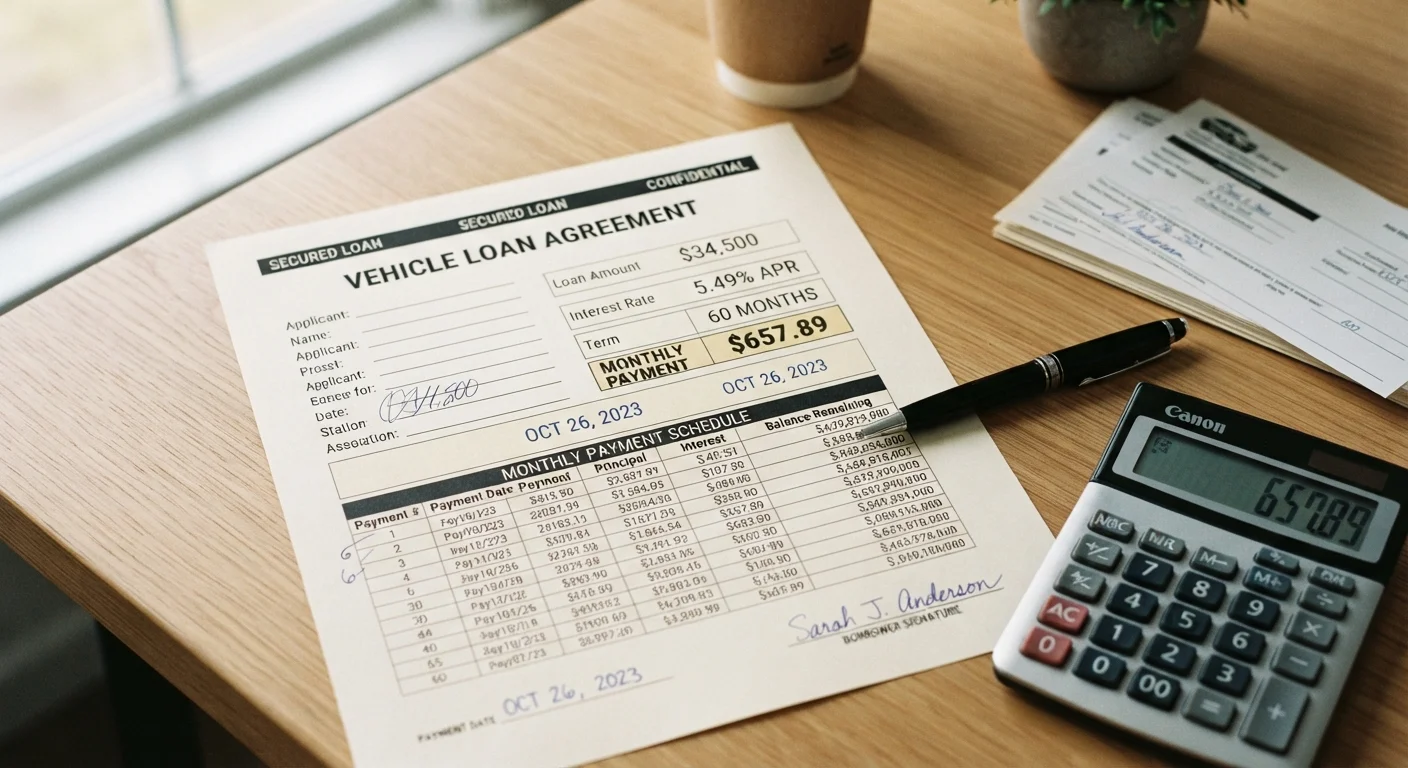
When you finance a vehicle, you're borrowing a principal amount and agreeing to repay it — plus interest — over a fixed number of months. That number of months is your loan term. The lender uses an amortization schedule to divide your total obligation into equal monthly payments across the term.
Because interest is charged on your remaining balance each month, longer terms mean more months of interest accumulation before the principal drops significantly. A 48-month loan on the same amount at the same rate will produce a higher monthly payment than a 72-month loan — but the 72-month borrower pays more in total interest by the time the final payment clears.
For a full breakdown of how principal, interest, and APR interact, see our guide to auto loan components.
Rates Often Vary by Term Length
Many lenders offer different interest rates depending on the term you choose, not just your credit profile. Shorter terms frequently qualify for lower APRs. This means the interest rate difference between a 48-month and a 72-month offer can compound the cost gap beyond what the term length alone would produce. Always ask for the APR — not just the monthly payment — for each term option.
The Trade-Off: Monthly Payment vs. Total Cost
The central tension in choosing a loan term is this: a longer term eases your monthly cash flow, while a shorter term reduces what you ultimately spend. Both effects are real, and neither should be ignored.
Consider a simplified illustration. Borrowing $28,000 at a 7% APR over 48 months produces a monthly payment near $670 and roughly $4,200 in total interest. Stretch that same loan to 72 months and the monthly payment drops to around $480 — but total interest paid climbs to approximately $6,500. The longer term costs meaningfully more in exchange for the lower monthly obligation.
72 months
Average new car loan term in recent years
Consumer Financial Protection Bureau data has shown the average new vehicle loan term has extended significantly over the past decade, with many borrowers selecting 72-month terms.
~$2,000–$3,000+
Typical extra interest on 72-month vs. 48-month loan
On a $25,000–$30,000 loan, extending from 48 to 72 months at a modestly higher rate commonly adds thousands in total interest, depending on APR and principal.
For a closer look at how these numbers shift across different scenarios, see how term length changes total cost with concrete comparisons.
Depreciation and Negative Equity Risk
Loan term interacts with vehicle depreciation in a way that catches many buyers off guard. New vehicles typically lose a significant portion of their market value within the first few years of ownership. If your loan balance decreases more slowly than the car's value declines — which is common with 72- and 84-month terms — you can end up upside down on the loan.
Being upside down means you owe more than the vehicle is worth. This creates real problems if you need to sell or trade in the car before the loan is paid off, or if the vehicle is totaled in an accident and your insurance payout doesn't cover the remaining balance. Understanding how term length builds or erodes equity is an important part of evaluating any financing offer.
Use a Loan Calculator Before You Decide
Before agreeing to a term, run the numbers using an auto loan amortization calculator. Enter the principal, APR, and each term option you're considering to compare total interest side by side. Many lenders and financial education sites offer free calculators. Seeing the full-cost difference — not just the monthly payment difference — gives you a clearer picture of what each term actually costs.
Choosing a Term That Fits Your Situation
There is no single correct loan term for every buyer. The right choice depends on your monthly budget, how long you plan to keep the vehicle, the interest rate you qualify for, and how much you're putting down upfront.
A larger down payment reduces the principal you're financing, which softens the monthly payment on a shorter term — making it more accessible without extending the loan. Financing strategies like down payment planning and trade-in use can shift the term calculation significantly.
Also consider the vehicle's expected lifespan. Committing to a 72-month loan on a high-mileage used vehicle carries more risk than the same term on a new car with a warranty. You could still be making payments after the car needs major repairs.
For a detailed look at how term selection fits into new-vehicle financing, review how loan terms shape your real cost before signing anything.
This article provides general financial education and is not personalized financial or lending advice. Loan terms, interest rates, and total costs vary based on individual creditworthiness, lender policies, and market conditions. Consult a licensed financial professional before making decisions about your specific situation.