
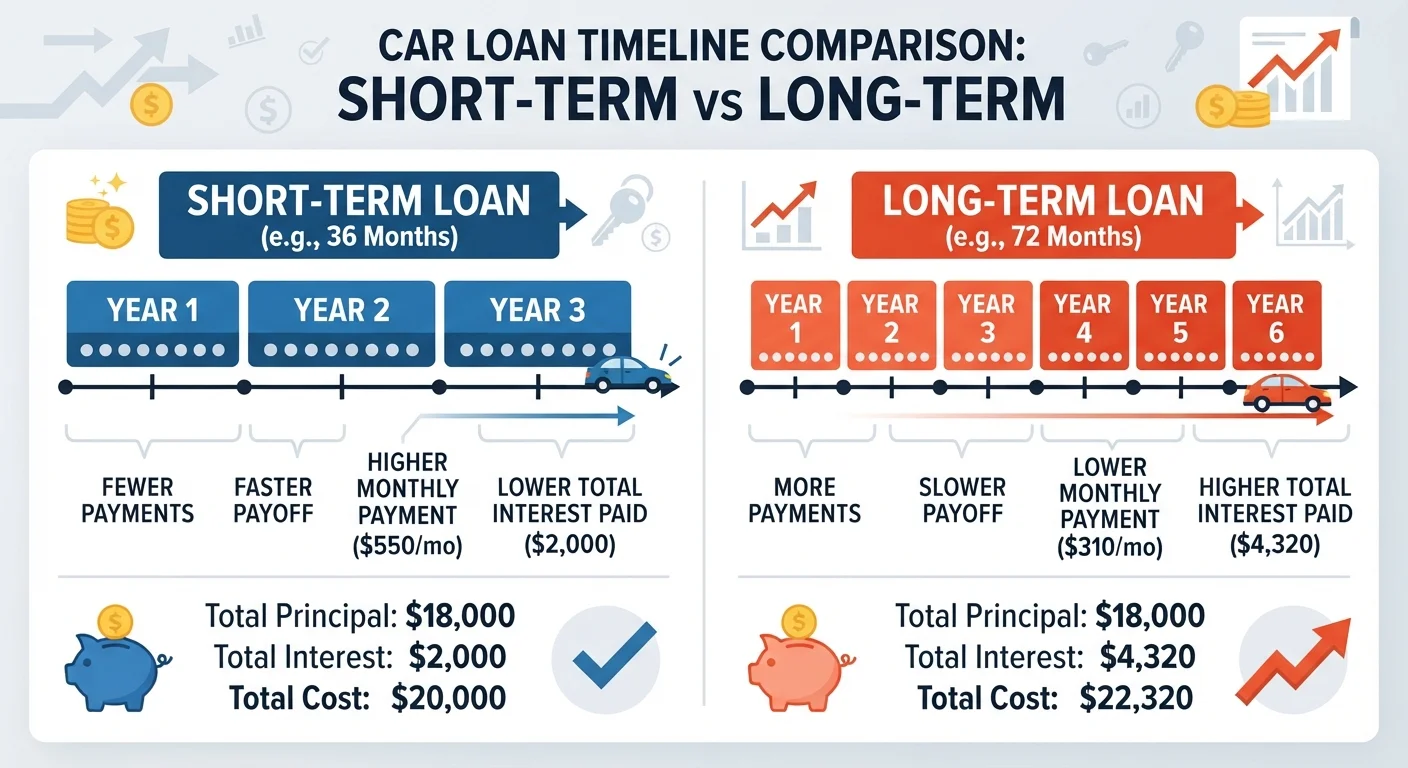
How Term Length Changes Every Number in a Loan
When you finance a vehicle, the loan term determines how many equal monthly payments you'll make to retire the debt. Because interest accrues on the remaining principal balance each month, a longer term means you're carrying that balance — and paying interest on it — for more months. The monthly payment is lower, but the cumulative interest bill rises.
Consider a simplified illustration: a $28,000 loan at a 7% APR. Over 48 months, the monthly payment is roughly $670 and total interest paid is approximately $2,150. Stretch that same loan to 72 months and the monthly payment drops to around $478 — but total interest climbs to about $3,400. That's more than $1,200 in additional cost for the convenience of a lower monthly obligation. For an 84-month term, the gap widens further.
Loan term length directly shapes what you actually spend, not just what you owe each month. Understanding that relationship is the foundation for evaluating any financing offer objectively.
~30%
Share of new auto loans with 72-month or longer terms
Industry data from consumer credit reporting organizations has consistently shown that a substantial portion of new-vehicle loans in the US extend to 72 months or beyond, reflecting the ongoing pressure on vehicle affordability.
$1,000+
Typical extra interest on a 72-month vs. 48-month loan
On a mid-size vehicle loan in the $25,000–$30,000 range at prevailing rates, extending from 48 to 72 months routinely adds more than $1,000 in total interest, based on standard simple-interest amortization calculations.
The Rate Wrinkle: Longer Terms Often Cost More Per Dollar Borrowed
Term length doesn't just affect total interest through duration alone — it often affects the interest rate itself. Lenders frequently assign slightly higher APRs to longer-term loans because extended repayment windows carry greater default and depreciation risk. A borrower who accepts a 72-month loan at a rate one point higher than a 48-month offer is paying a compounded penalty: more months at a higher rate against a slower-declining balance.
This is why comparing term lengths requires looking at the full cost over time, not just the rate or the payment in isolation. Ask any lender for the total amount financed, the APR, and the total of all payments — these three figures together reveal what you're actually agreeing to pay for the vehicle.
Ask for the Total of All Payments
When reviewing any loan offer, request the total of all scheduled payments — not just the monthly amount and rate. This single figure shows exactly what you'll pay for the vehicle plus all financing charges combined, making comparisons between different term offers straightforward and honest.
Depreciation, Equity, and the Risk of Owing More Than the Car Is Worth
New vehicles depreciate rapidly, often losing 15–25% of their value within the first year and continuing to decline through the first five years of ownership. On a long-term loan, the loan balance shrinks slowly in the early months — most of each payment covers interest rather than principal — while the car's market value drops quickly.
The result is negative equity, sometimes called being "upside down." If you need to sell, trade in, or the vehicle is totaled by an insurer, you may owe more than the car is worth. This can force you to roll unpaid debt into your next loan, compounding the problem. Stretching payments across 72 or 84 months raises this risk meaningfully.
Making a Term Decision That Works for Your Budget
The practical question isn't simply "shorter is better" — it's whether the monthly payment on a shorter term is genuinely sustainable for your budget. Overcommitting to a payment you can't reliably meet creates its own financial risks. The goal is to find the shortest term where the monthly payment fits comfortably within your overall budget without squeezing out emergency savings or other obligations.
A larger down payment is one of the most effective levers available. By reducing the principal borrowed, you lower the monthly payment at any term — which may make a shorter, lower-cost term feasible. Financing strategies like adjusting your down payment and trade-in can shift that calculation significantly before you ever discuss rates.
Avoid optimizing purely for the monthly payment figure. As detailed in our related guidance on why focusing only on monthly payments gets buyers into trouble, a lower monthly number can mask a much higher total cost. Evaluate loan offers using the annual percentage rate, the total of all scheduled payments, and the loan term together — not any single figure alone.
This article is for general informational and educational purposes only and does not constitute personalized financial or lending advice. Loan rates, terms, and total costs vary by lender, credit profile, and market conditions. Consult a qualified financial professional before making borrowing decisions that affect your personal finances.