
Why Depreciation Is Central to the New vs. Used Question
When buyers weigh a new car against a used one, they often focus on sticker price, features, or financing rates. But one of the most consequential factors — depreciation — frequently goes unexamined. Understanding how vehicles lose value, and when, can reframe the entire decision.
Depreciation isn't an abstract accounting concept. It directly determines what a vehicle is worth when you're ready to sell or trade it in, how much you pay per mile of use, and whether you're building any equity in the vehicle at all. For most buyers, it's the single largest cost of ownership over a three-to-five-year period — often surpassing fuel, insurance, or maintenance.
See the full financial comparison of new vs. used cars for a broader look at how these costs stack up across the ownership timeline.
~20%
Average first-year new car value loss
Industry data consistently shows new vehicles lose roughly 15–25% of their value in the first 12 months, making year one the steepest part of the depreciation curve.
~50%
Value retained after five years (average vehicle)
Many vehicles retain roughly half their original value after five years of ownership, though this varies significantly by segment and market conditions.
Years 1–3
Period of steepest depreciation loss
The first three years account for a disproportionate share of total lifetime depreciation, which is why lightly used vehicles can represent strong financial value.
When Depreciation Hits Hardest
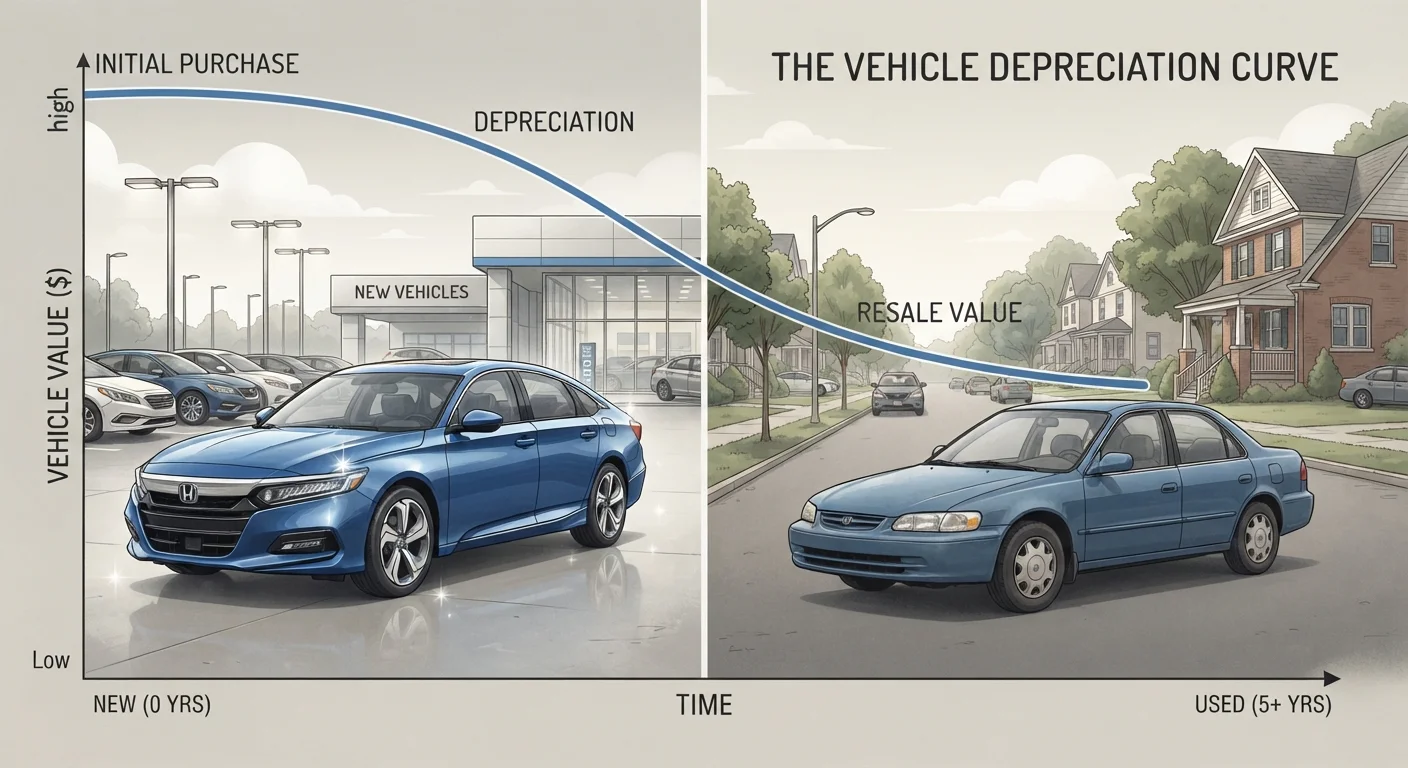
Depreciation is not evenly distributed across a vehicle's life. The curve is front-loaded: the largest losses happen earliest, with the rate tapering as the car ages.
In the first year of ownership, a new vehicle typically loses a substantial share of its purchase price. By years two and three, additional value is shed, though at a slower pace. By the time a car reaches four to six years old, depreciation has often moderated significantly. The vehicle is losing less value per year in dollar terms, even if it's worth considerably less in total than when new.
This curve is why the timing of a used car purchase matters so much. A vehicle that's two or three years old has already absorbed the steepest part of the depreciation curve — meaning the buyer who purchases it at that stage avoids the most dramatic value loss.
Look Up Residual Values Before You Buy
Before committing to a new or used purchase, research how vehicles in that segment have historically held their value over three-to-five years. This information is publicly available through automotive valuation tools and can reveal meaningful differences between comparable models. A vehicle with a stronger resale trajectory can reduce your effective cost of ownership even if its sticker price is higher.
What This Means for New Car Buyers
Buying new comes with real advantages: full warranty coverage, the latest safety technology, and the certainty of a vehicle's history. But new car buyers absorb the steepest portion of the depreciation curve by definition. If you plan to keep a new vehicle for ten or more years, or drive very high mileage, the per-year depreciation cost may be more manageable. The longer you hold the vehicle, the more that early loss is spread across more years of use.
However, buyers who tend to trade in or sell within three to five years face a meaningful financial headwind from depreciation. If the loan balance exceeds the vehicle's current market value at any point — a situation sometimes called being "underwater" or having negative equity — it can complicate future trade-ins or sales.
For a closer look at why new vehicles lose value so quickly, see our article on new car depreciation and what it means for buyers.
How Used Car Buyers Benefit — and What to Watch
Used car buyers enter the ownership equation after the first owner has absorbed the heaviest depreciation losses. This creates a structural cost advantage: for the same amount of money, a used buyer typically gets a vehicle with more original value baked in.
That said, used car buyers face their own set of considerations. Vehicles past their original warranty period may require more maintenance. Market demand — as seen during periods of inventory shortage — can compress the normal depreciation discount, making used cars less of a bargain than the underlying math would suggest.
The new vs. used tradeoffs hub walks through these competing factors in detail, helping buyers weigh cost savings against reliability risk.
Understanding where a specific vehicle sits on its depreciation curve — and comparing that against its condition, mileage, and ownership history — is the foundation of a well-reasoned used car purchase. Depreciation explains price differences; it doesn't automatically determine value.
This article provides general educational information about vehicle depreciation and is not financial advice. For guidance specific to your situation, consult a qualified financial professional.