
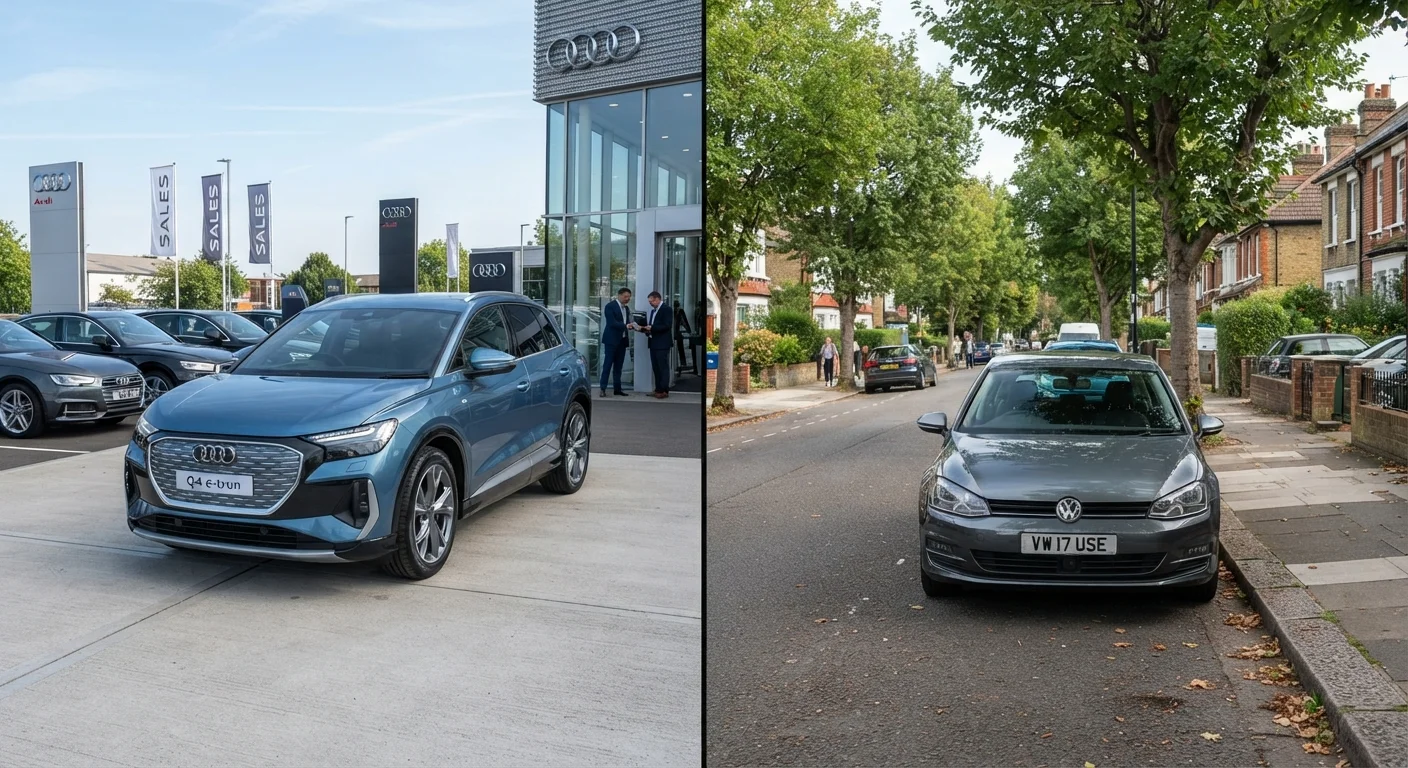
The Real Price Gap: Sticker vs. Total Cost
The purchase price is the number buyers fixate on, but it is only the starting point. A new vehicle carries its MSRP (Manufacturer's Suggested Retail Price), destination charges, and often dealer add-ons. A comparable used vehicle — say, two to four years old with moderate mileage — might list at 20–35% less. That gap looks compelling on paper.
However, total cost of ownership includes financing interest, insurance premiums, fuel, scheduled maintenance, unplanned repairs, and eventual resale value. When all of those are added up over a five-year horizon, the gap between new and used frequently narrows — and in some scenarios reverses. Used cars can sometimes cost more than new ones once higher interest rates, missing warranties, and early repairs are factored in.
~20%
Average new car value lost in year one
Industry data consistently shows new vehicles lose between 15–25% of value in the first 12 months of ownership.
1–3%
Typical rate gap: new vs. used auto loans
Used vehicle loans have historically carried higher APRs than new vehicle loans, with the spread varying by lender, credit profile, and vehicle age.
~50%
Value retained after three years (average new car)
Residual value studies suggest the average new vehicle retains roughly half its purchase price at the three-year mark, though this varies significantly by model.
The clearest way to compare is to build a simple five-year cost model for each option using your actual loan quote, expected mileage, and insurance estimate — not industry averages.
Depreciation: Who Absorbs the Loss
Depreciation is the single largest ownership cost most buyers never see itemised. A new vehicle typically loses 15–25% of its value in the first year alone, and roughly 50% within three years, depending on the model and market conditions. The buyer who purchases new and sells at year three absorbs that steepest part of the curve.
A used buyer who acquires that same vehicle at the three-year mark faces a shallower depreciation slope going forward. This is the core financial argument for used: you let the first owner absorb the heaviest loss. Depreciation shapes the new vs. used decision more than almost any other factor, and it compounds with ownership length.
Target vehicles that are two to four years old with under 40,000 miles — you capture most of the depreciation benefit while the powertrain is still relatively young and maintenance costs are low.
This window typically sits past the steepest part of the depreciation curve but before the period when major component failures become statistically more likely.
Before accepting a used car loan rate, check whether any manufacturer-certified lending programs are available for the used vehicle you are considering — some automakers extend competitive rates to CPO inventory.
CPO financing programs can partially offset the rate disadvantage of used car loans, narrowing the financing cost gap versus new.
That said, depreciation rates vary significantly by segment. Some vehicles hold value unusually well, making the new-versus-used price gap smaller and the case for used weaker. Checking published residual value data before assuming a large gap is worth the effort. See also the full depreciation comparison by vehicle age for a more detailed breakdown.
Financing Costs: Rates, Terms, and What They Actually Mean
Lenders treat new and used loans differently. New vehicles qualify for lower interest rates — sometimes significantly lower, and occasionally manufacturer-subsidised promotional rates — because they carry predictable collateral value and lower lender risk. Used vehicles, particularly those over five years old or with higher mileage, attract higher rates and shorter maximum terms.
Consider a simplified illustration: on a $30,000 new car financed at 5% over 60 months, total interest paid is roughly $4,000. A used car purchased at $22,000 but financed at 8% over 48 months produces about $3,700 in interest — a smaller absolute figure, but a much higher effective rate on the underlying asset. The monthly payment difference may be modest while the rate difference is substantial. How financing differs between new and used cars is worth understanding before you assume the lower sticker price means lower borrowing cost.
Long Loan Terms on Used Cars Carry Risk
Financing a used vehicle over 60–72 months keeps monthly payments low but means you may still owe money on a car that needs expensive repairs — or has depreciated below the loan balance. This is sometimes called being 'underwater' on your loan. Shorter loan terms or a larger down payment reduce this exposure significantly.
Loan term length also matters. Stretching a used car loan to 72 months to lower monthly payments on a vehicle that may need significant repairs in years four through six is a common financial misstep.
Insurance, Maintenance, and Running Costs
New vehicles generally cost more to insure. Comprehensive and collision coverage is typically required by lenders and is priced against replacement cost — which is higher on a new car. A three-year-old equivalent may carry notably lower premiums, particularly if the owner opts to reduce coverage once the loan is paid off.
Maintenance costs run in the opposite direction over time. New cars benefit from factory warranty coverage — typically three years or 36,000 miles for basic defects, longer for powertrain — meaning unexpected repairs cost the owner little or nothing in the early years. Used vehicles outside warranty transfer that repair risk entirely to the buyer. Comparing upkeep costs between older and newer vehicles shows how these curves intersect over time.
Certified Pre-Owned (CPO) programs offered through franchised dealers partially bridge this gap by extending limited warranty coverage to qualifying used vehicles, though CPO vehicles carry a price premium over comparable non-certified used cars. The full picture on buying used covers both the warranty angle and the risks buyers should scrutinise.
How to Frame the Decision for Your Situation
No single answer fits every buyer. The relevant variables are: how long you plan to own, what financing rate you actually qualify for, your tolerance for repair uncertainty, and whether you drive enough miles to accelerate depreciation on a new purchase.
- Plan to own 7+ years: A new car's depreciation burden spreads across more years, and the warranty covers the period when repair costs would otherwise be highest. Buying new can make financial sense here.
- Plan to own 3–4 years: You will absorb the steepest depreciation slope on a new car and exit near the point where a used buyer would have entered. A well-chosen used vehicle typically wins on total cost.
- Credit score and rate access: If you qualify for a manufacturer promotional rate well below market, that shifts the calculus toward new. If your rate on a new loan is close to the used loan rate, the spread narrows.
- Risk tolerance: Used cars outside warranty require a financial cushion for repairs. If an unexpected $2,000–$4,000 repair would strain your budget, the certainty of a new car warranty has real monetary value.
Build Your Own Five-Year Cost Model
Before deciding, estimate five-year total cost for each option: purchase price minus projected resale value, plus total loan interest, insurance premiums, and a realistic maintenance and repair allowance. This single exercise surfaces the true financial difference more clearly than any sticker price comparison. Free online auto loan calculators and ownership cost estimators can help you assemble the numbers quickly.
A complete framework for the new vs. used decision can help you work through these variables systematically. And if you are still weighing the fundamentals, the core trade-offs between new and used is a useful grounding read before you commit.
This article provides general financial information for educational purposes only. It is not personalised financial or legal advice. Loan rates, insurance premiums, depreciation, and ownership costs vary by individual circumstances, vehicle, lender, and region. Consult a qualified financial adviser or licensed insurance professional for guidance specific to your situation.