
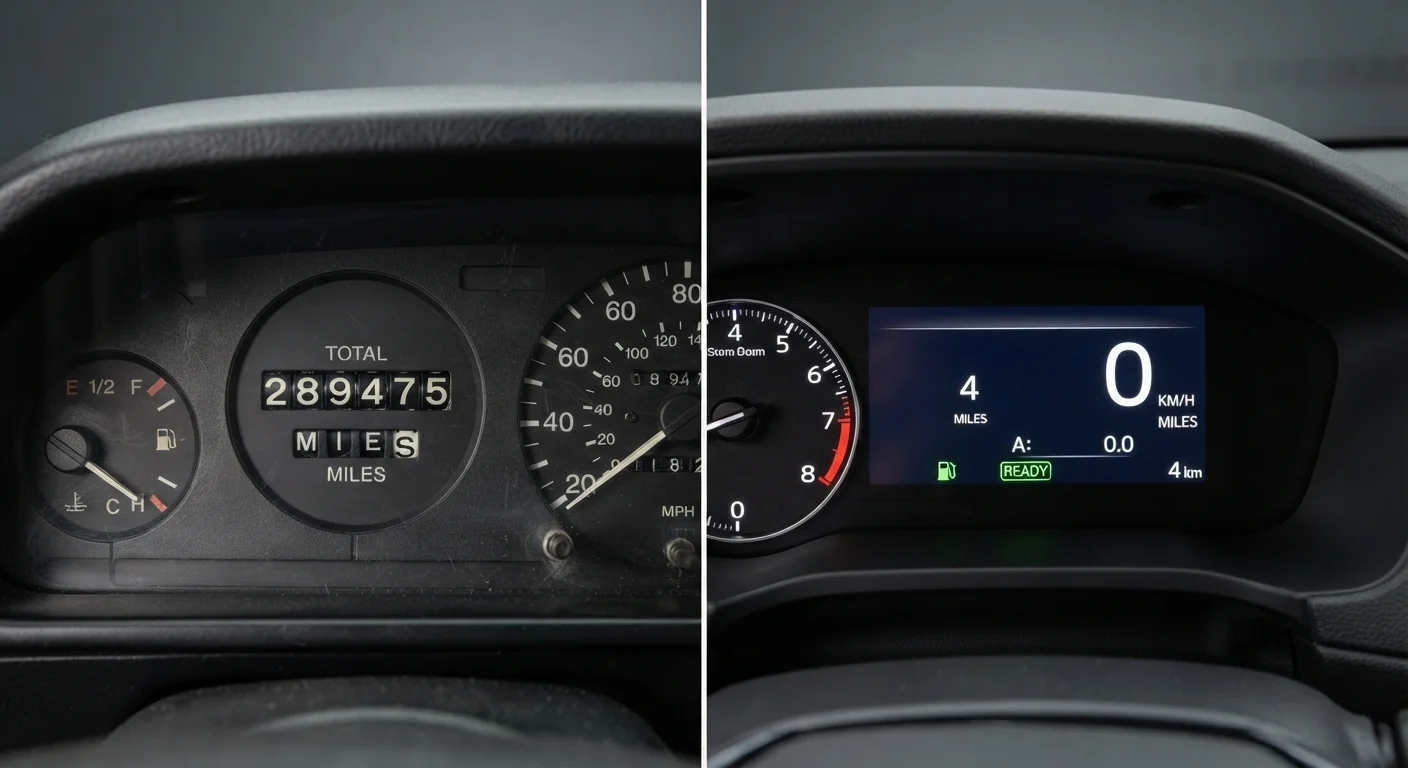
Why Odometer Readings Dominate First Impressions
Mileage is the single most visible data point in any used car listing. It's front and center because it's easy to compare — but that simplicity is also its biggest limitation. The odometer tells you how far a car has traveled; it says almost nothing about how it was driven, maintained, or stored.
In the US, the Federal Highway Administration estimates the average driver logs around 13,500 miles per year. That benchmark gives buyers a rough sanity check: a five-year-old car with 67,500 miles is roughly average; one with 30,000 miles is low; one with 110,000 miles is high. But average mileage doesn't mean average condition, and that's where buyers frequently go wrong.
Mileage primarily matters because of its relationship to depreciation. Lenders, insurers, and valuation tools like those used by dealers all use mileage as a key pricing input — typically applying a per-mile penalty below or above a baseline. That's useful for setting prices, but it can create misleading price signals when condition and history aren't factored in. For a deeper look at how these readings feed into long-term reliability, see how mileage affects a used car's long-term reliability.
What High Mileage Actually Indicates
A high odometer reading raises a legitimate question: how much wear have the drivetrain, suspension, and ancillary systems accumulated? But high mileage is not automatically a red flag. Highway miles — steady-speed, low-stress driving — are far gentler on mechanical components than the same number of miles accumulated in stop-and-go urban commuting.
Vehicles used primarily for long highway commutes can reach 150,000 miles with engines and transmissions in surprisingly good condition, provided oil changes and scheduled services were completed on time. Conversely, 60,000 city miles with irregular maintenance can leave a powertrain in worse shape than a highway-driven 120,000-mile equivalent.
| Criterion | High-Mileage Vehicle | Low-Mileage Vehicle |
|---|---|---|
| Purchase price | Lower — depreciation is steeper | Higher — premium for fewer miles |
| Mechanical wear risk | Higher if poorly maintained | Lower from miles; higher from age/inactivity |
| Service history importance | Critical — must be verified | Still essential; infrequent service harms cars |
| Depreciation going forward | Flatter — much already taken | More headroom still to depreciate |
| Inspection priority areas | Drivetrain, transmission, wear items | Seals, fluids, rubber, brake condition |
| Typical buyer profile | Value-focused, mechanically informed | Risk-averse, willing to pay premium |
High-mileage vehicles also offer a real financial advantage: steeper depreciation means a lower purchase price. If a pre-purchase inspection by a qualified mechanic reveals sound mechanical condition and the service records are verifiable, a high-mileage car can represent genuinely good value. The key is treating the odometer as a starting point for investigation rather than a final verdict.
The Hidden Risks of Low Mileage
Low mileage carries a halo effect that isn't always deserved. Buyers instinctively equate fewer miles with less wear — but mechanical systems are also degraded by time and inactivity, not just distance.
A car driven only 3,000 miles per year for a decade still has ten-year-old rubber seals, brake fluid, coolant, and timing belts. Gaskets can harden and crack. Brake rotors can rust significantly from sitting. Fuel systems in older low-mileage cars can develop deposits if ethanol-blended fuel sat in the tank. These are issues that wouldn't appear on the odometer but can be expensive to address.
Time Takes a Toll Too
Automotive fluids, seals, and rubber components degrade on a time-based schedule, not just a mileage-based one. A car that's been driven only occasionally over many years can have coolant, brake fluid, and belts well past their service life despite a low odometer. Always check the date of the last service, not just how recently it was done by the mile.
Low mileage also doesn't protect against accident history, flood damage, or deferred maintenance — all of which can be concealed behind an attractive number. Mileage myths that mislead buyers explores exactly why the odometer can be one of the most misunderstood figures in a used car transaction.
Low-mileage cars do command a price premium, and that premium isn't unjustified across the board — but it needs to be weighed against the actual condition of the vehicle, not assumed as a given.
How Buyers and Valuers Actually Use These Numbers
Valuation models treat mileage as a depreciation accelerator. In practical terms, each mile above a threshold — often set around 12,000–15,000 miles per year — tends to reduce a vehicle's estimated market value, while miles below that threshold may support a modest premium. However, this is a pricing convention, not a mechanical guarantee.
Savvy buyers use mileage as a filter, not a decision. After filtering by acceptable mileage ranges, the real evaluation begins: ownership history, service records, accident reports via vehicle history services, and a physical inspection. The interaction between age and mileage is particularly important — and age vs. mileage: which matters more breaks down exactly how these two variables interact to affect value and running costs.
~13,500
Average annual miles driven per US driver
According to Federal Highway Administration data, this figure serves as a standard baseline when evaluating whether a used car's mileage is above or below average for its age.
~50%
Typical depreciation in first three years
Industry valuation benchmarks suggest many new vehicles lose around half their value within three years, with mileage being one of the primary factors accelerating that loss.
When reviewing listings, pay attention to what's around the mileage figure. Reading a used car listing effectively outlines which adjacent data points — service intervals, number of previous owners, use type — give real context to whatever number appears on the odometer.
This article provides general educational information about vehicle valuation and is not a substitute for advice from a qualified mechanic or professional vehicle appraiser. Individual vehicles vary significantly; always conduct a pre-purchase inspection before any transaction.