
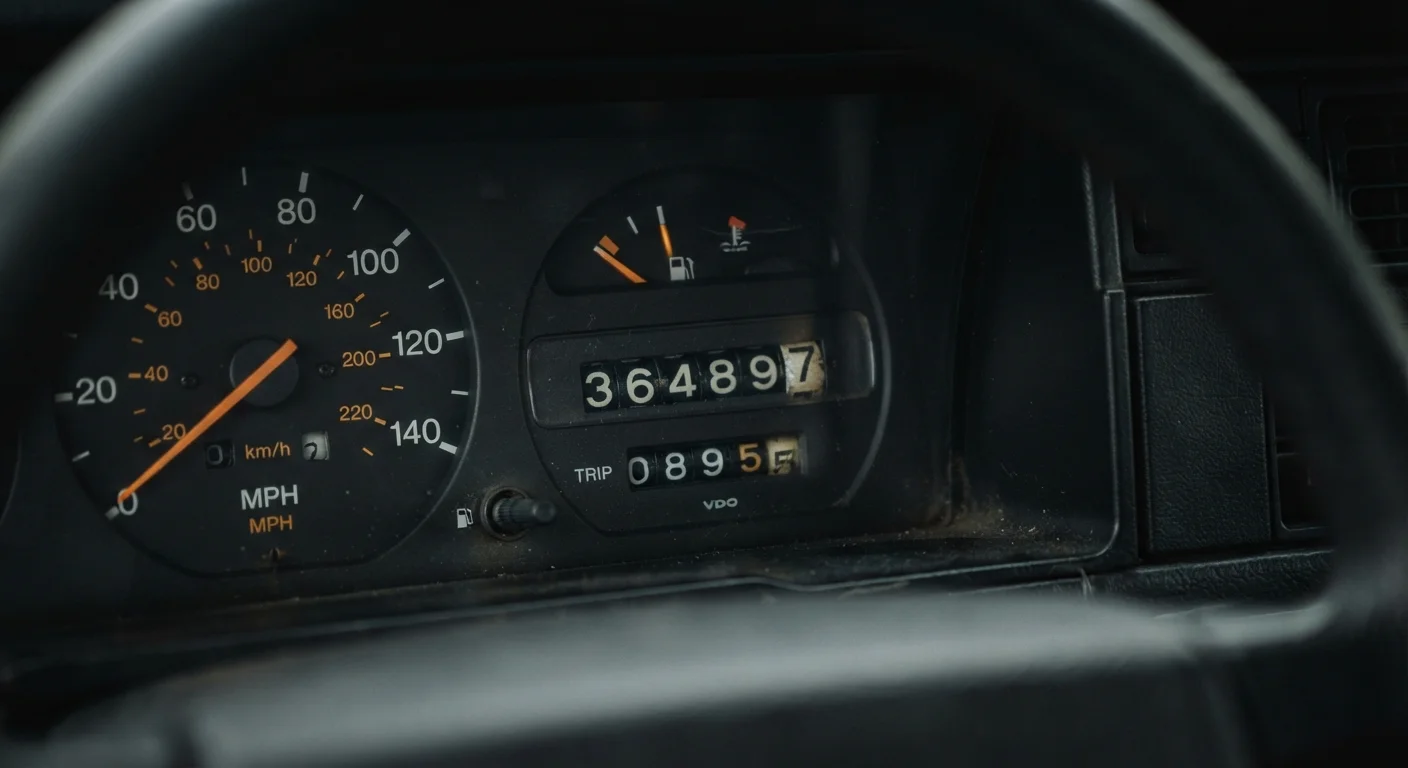
Why Mileage Gets Too Much Credit
Odometer readings are one of the first numbers buyers check — and one of the most misread. A six-figure number triggers immediate caution; a suspiciously low reading seems like a bargain. But mileage is a single variable in a much larger equation, and treating it as the headline metric leads buyers into predictable, costly mistakes.
The core problem is that mileage measures usage quantity, not usage quality. A vehicle driven 150,000 miles on steady highway commutes, serviced on schedule, may be mechanically sounder than one showing 60,000 miles of urban stop-start driving with a patchy maintenance record. The odometer doesn't tell you which scenario you're looking at. For a fuller picture of how mileage and vehicle age interact, see how age and mileage work together when evaluating a used car.
Myth
High mileage always means the car is worn out and about to break down.
Fact
Mileage reflects how much a car has been driven, not how well it was maintained — a high-mileage car with complete service records can be more reliable than a low-mileage car that was neglected.
Modern engines and drivetrains are engineered for longevity. Many well-maintained vehicles comfortably exceed 200,000 miles. What accelerates wear isn't distance — it's deferred oil changes, ignored coolant flushes, and skipped timing belt replacements. A vehicle with 130,000 miles and a documented service history may have substantially less mechanical stress than one with 50,000 miles and no paperwork trail whatsoever.
Myth
Low mileage is always a sign of a well-preserved, reliable car.
Fact
Very low mileage relative to a car's age can indicate long periods of inactivity, which causes its own set of mechanical problems including degraded rubber seals, corroded brake components, and stale fluids.
Cars are designed to be driven. When a vehicle sits unused for extended periods, gaskets and seals dry out, fuel systems can gum up, and brake rotors may corrode unevenly. A 12-year-old car with 18,000 miles raises legitimate questions: why was it barely driven? Was it stored properly? These aren't disqualifying factors, but they warrant a thorough pre-purchase inspection rather than assumption of a lucky find.
Myth
There's a universal mileage threshold — say, 100,000 miles — beyond which a car becomes too risky to buy.
Fact
No universally reliable cutoff exists; risk depends on vehicle make, maintenance history, age, and how those miles were accumulated, not a single number.
Some vehicle platforms are well-documented to run reliably well beyond 150,000 miles with routine maintenance. Others develop known issues at much lower mileage. The source of those miles matters too: predominantly highway miles are gentler on most drivetrain components than equivalent urban miles. Blanket mileage thresholds are a simplification that doesn't hold up when applied across different vehicles and ownership histories.
Myth
Highway miles are always better than city miles.
Fact
Highway driving is generally easier on engines and transmissions, but it increases wear on other components and doesn't override the importance of maintenance quality.
The logic behind preferring highway miles is sound in a limited sense: sustained cruising puts less thermal and mechanical stress on the engine and transmission compared to constant stop-start cycling. However, highway driving at higher sustained speeds wears tires and brakes differently, and a car with exclusively highway history may have had fewer opportunities for a dealer or shop to spot emerging issues. Maintenance consistency matters more than road type.
Myth
You can accurately judge a car's condition just by reading the odometer.
Fact
The odometer provides a usage quantity figure only; condition requires assessing service records, a physical inspection, and a vehicle history report.
Two cars with identical odometer readings can be in vastly different states of repair. One may have had every service completed on time by a meticulous owner; the other may have limped through deferred maintenance, minor accidents, and flood exposure. The odometer captures none of that. A pre-purchase inspection by an independent, qualified mechanic — not a dealer's in-house shop — is the most reliable way to assess actual mechanical condition before committing to a purchase.
What Odometer Readings Actually Signal
Once you move past myths, mileage does carry real information — just more nuanced than a simple pass/fail threshold. Higher mileage means more wear on consumable components: brakes, tires, belts, and fluids. It also tends to compress resale value, which can work in a buyer's favor if the mechanical condition is still solid.
Mileage relative to vehicle age is more telling than raw mileage alone. A 10-year-old car with 80,000 miles has averaged about 8,000 miles annually — below the roughly 12,000–15,000 mile U.S. average. That's not inherently reassuring; it may mean the car spent long stretches sitting, which creates its own maintenance concerns. How mileage affects long-term reliability covers this interaction in detail.
~12,000–15,000
Average annual miles driven in the U.S.
Federal Highway Administration data consistently places average U.S. annual vehicle mileage in this range, making it a useful benchmark when evaluating mileage relative to a car's age.
200,000+
Miles many modern vehicles can reach with proper maintenance
Consumer research and automaker durability testing suggest well-maintained modern vehicles can routinely exceed 200,000 miles, though this varies significantly by model and maintenance history.
Ultimately, mileage should be one input into a broader pre-purchase checklist. A vehicle history report, a current inspection by an independent mechanic, and a review of the service records will tell you far more than the odometer reading alone. See which listing details actually matter for a practical breakdown of what to prioritize.
Odometer Tampering Is Still a Real Risk
Digital odometers are harder to roll back than mechanical ones, but tampering still occurs. A vehicle history report from a recognized provider can flag mileage discrepancies across recorded service visits, insurance claims, and inspections. If reported mileage across a car's history shows a suspicious drop or gap, treat it as a serious red flag and walk away or investigate further before proceeding.
For a broader look at common misconceptions that end up costing buyers money, the used car myths that cost buyers money is worth reading alongside this one. And if you're weighing how mileage feeds into market value and depreciation, what odometer readings really signal to valuers provides a useful counterpoint.
This article is for general informational purposes only. Vehicle condition, reliability, and value depend on many factors specific to each car and situation. Always have a used vehicle inspected by a qualified mechanic before purchase.