
Why the Number on the Sticker Misleads You
Walk into any dealership or browse any manufacturer website and you'll find cargo volume listed in cubic feet. It looks precise and comparable. It often isn't — at least not for the way most people actually load a car.
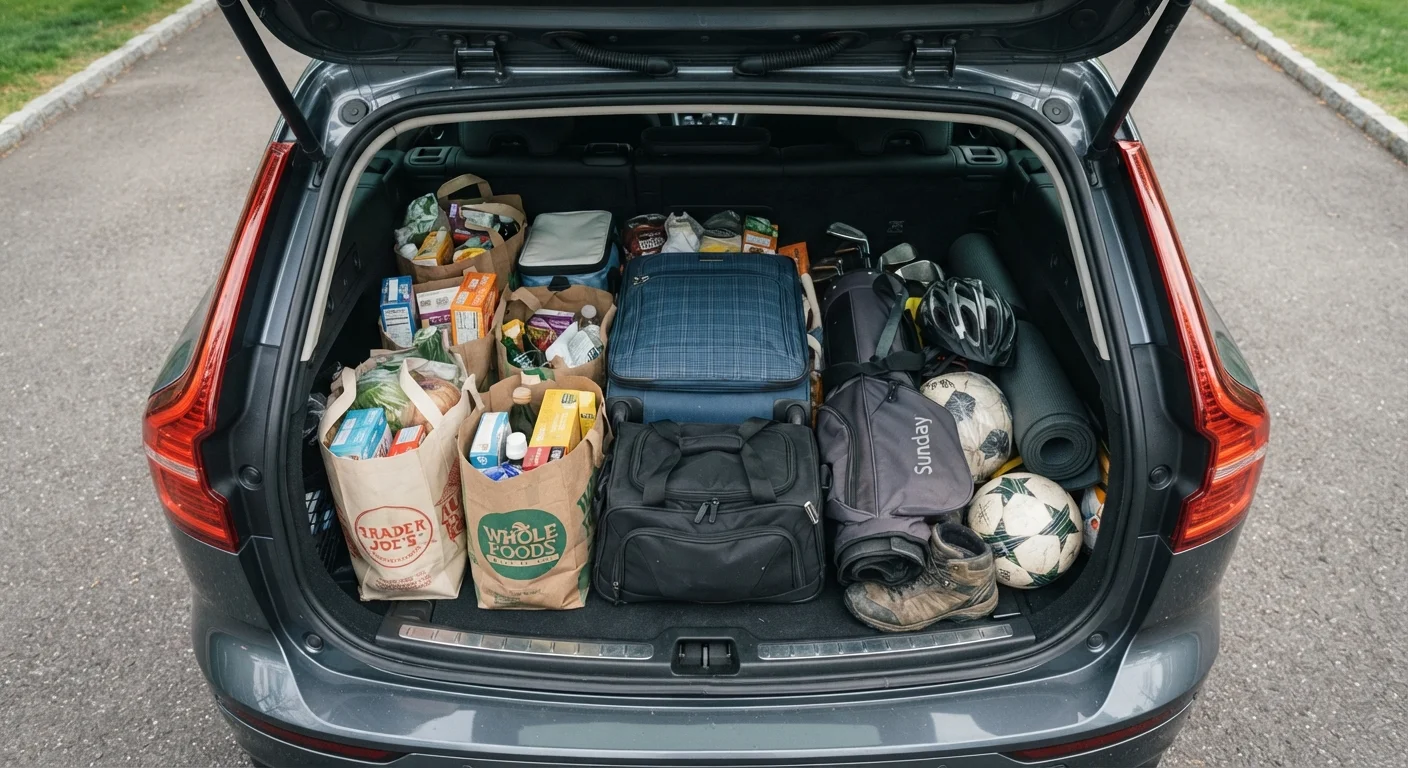
The standardized measurement fills the cargo area mathematically, accounting for every available cubic inch including low recesses, narrow side pockets, and the space beneath the floor. Real cargo — grocery bags, strollers, toolboxes, duffel bags — is rigid and irregular. It can't conform to those corners. The result: a vehicle with 30 cubic feet of advertised space may hold meaningfully less than that in practical terms.
Load floor shape compounds the issue. A cargo area that is wide, low, and square is far more usable than an equal-volume space that is tall, narrow, and irregular. Wheel arch intrusions and angled side walls can make a segment-competitive number feel cramped when you're actually loading gear. As explained in our guide on what vehicle segment numbers actually mean, raw measurements rarely capture real-world differences you can feel.
~15–20%
Typical gap between advertised and practical cargo volume
Independent automotive testing has generally found that real-world usable cargo capacity can fall 15–20% below manufacturer-stated cubic footage due to irregular load shapes and structural intrusions.
2x+
Cargo volume difference: seats up vs. seats folded
On many three-row SUVs, maximum cargo volume with all rows folded can exceed behind-third-row volume by more than double, illustrating how configuration-dependent these figures are.
~23 cu ft
Typical compact SUV cargo volume behind rear seats
Compact SUVs in the US market commonly offer roughly 23–28 cubic feet of cargo space behind the second row, though load floor shape varies significantly across models.
Body Style Shapes the Experience, Not Just the Volume
The body style of a vehicle determines not just how much cargo space it has, but how accessible and flexible that space is — and those factors matter more than the headline number.
Sedans separate the trunk from the passenger cabin with a solid parcel shelf. That isolation is useful for keeping odors and noise from groceries or gym bags contained, but it also means loading long items — skis, lumber, flat-pack furniture — is often impossible. The trunk opening itself is frequently the limiting factor; a narrow aperture can make even a generously sized trunk difficult to fill efficiently.
Hatchbacks open the rear wall entirely, giving a much larger access point and allowing the rear seat to function as an extension of the cargo area. The trade-off is less separation between passengers and cargo. Choosing between a sedan, hatchback, or wagon is fundamentally a question of how you'll use that space day to day.
Wagons extend the roofline rearward, creating a tall, square cargo area that is often more shape-efficient than an SUV of comparable volume. A flat load floor — especially after folding rear seats — makes wagons particularly practical for bulky, flat items.
SUVs offer a higher cargo floor, which eases loading heavy items without bending, but the floor-to-ceiling height adds volume that isn't always useful. Maximum cargo figures on SUVs include the full fold-flat configuration, which is only relevant when passengers aren't present.
Check the 'Behind Second Row' Figure First
When comparing SUVs or wagons, always locate the cargo volume measured behind the second row — not the maximum fold-flat figure. The behind-second-row number reflects everyday use when passengers are present. Maximum figures are useful for occasional large hauls but shouldn't drive your decision if you regularly carry people and gear simultaneously.
The Measurements That Actually Matter
Rather than fixating on a single cubic footage figure, look at several secondary measurements that manufacturers publish but rarely emphasize:
- Cargo floor width at the narrowest point — this determines whether a standard pallet or flat-pack box fits between the wheel arches.
- Load floor height from ground — a lower sill means easier loading for heavy items, though it can also mean less underfloor storage.
- Cargo opening height and width — the aperture through which everything must pass. A small opening limits usable space regardless of the volume inside.
- Behind second row vs. maximum volume — on SUVs and wagons, always ask for both figures. The behind-second-row number reflects typical use.
These secondary figures are frequently published in the full specification sheets available on manufacturer websites or reference databases, though they're rarely highlighted in advertising. If they're not listed, a tape measure during a test drive reveals more than any spec sheet.
It's also worth understanding how misreading a vehicle segment leads buyers to assume capacity they won't get. A 'midsize' SUV label doesn't guarantee the cargo room that label implies.
Testing Cargo Space Before You Buy
The only reliable way to assess cargo space is to bring your actual cargo. Most dealerships allow — and expect — buyers to open hatches, fold seats, and inspect the load floor during a test drive. Take advantage of this.
If you regularly haul a stroller, bring it. If you take road trips with a family of four and need all seats occupied plus luggage, load your actual bags while all seats are in use. If you carry sports equipment seasonally, measure the longest item and check it against the vehicle's listed interior length.
Pickup trucks represent a different calculation entirely — the bed offers open-air capacity that spec sheets handle differently. For that perspective, our article on pickup trucks as daily drivers covers the trade-offs that come with bed-based utility.
The goal is to match the vehicle's actual loading behavior to your lifestyle — not to find the largest number on a spec sheet. A smaller vehicle with a flat floor and wide opening will often outperform a technically larger one for the cargo you carry most often.
“Cargo volume is a starting point for comparison, not a finishing point. The shape of the space, the height of the sill, and the width of the opening often matter more than the number itself when it comes to what you can actually load.”
— Car Types Explained Editorial Team, Automotive content specialists focused on practical vehicle selection