
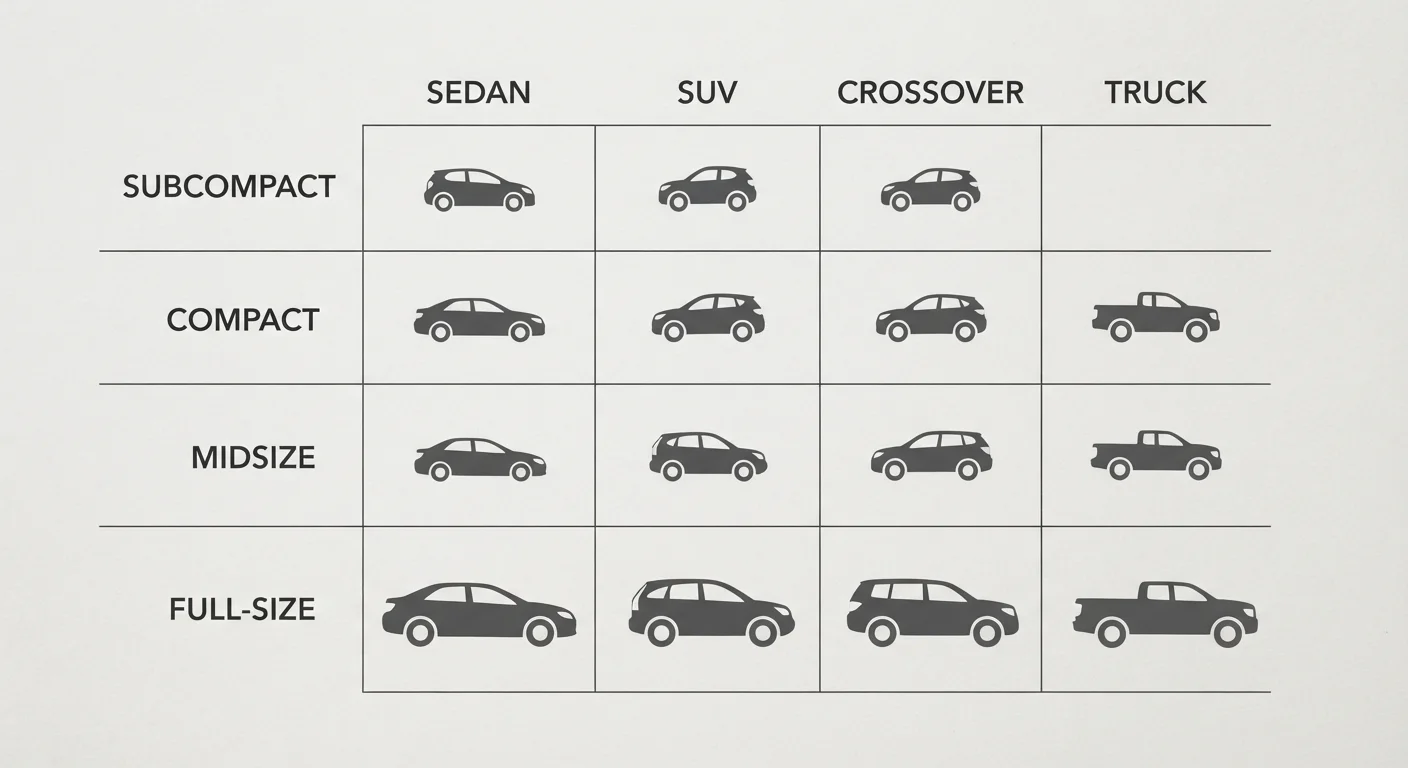
Why the Confusion Exists
Walk into a dealership and describe the car you want as a "midsize SUV" — most salespeople will understand you. But technically, you've just blended two classification systems without realizing it: midsize is a segment label, and SUV is a body style label. The auto industry uses both simultaneously, and manufacturers rarely stop to explain which label belongs to which system.
Much of the confusion comes from the fact that certain body styles dominate certain segments. Pickup trucks, for example, are nearly always full-size or midsize in segment terms — so buyers start to treat "truck" and "full-size" as synonyms. They're not. Understanding why these systems are separate gives you a much more precise tool for filtering your search.
Industry Labels Are Not Standardized
No single regulatory body dictates how automakers must label their vehicles by segment. A vehicle one brand calls a 'compact crossover' might be classified as a 'small SUV' by a market research firm and a 'subcompact utility' by a safety organization. The systems are useful frameworks, not rigid legal definitions. Always verify actual dimensions and cargo figures rather than relying on the label alone.
What Body Style Actually Means
Body style describes the physical architecture of a vehicle: how the cabin, cargo area, and roof are structured. It's a visual and structural classification. The major body styles you'll encounter in the US market include:
- Sedan: A three-box design with separate engine, passenger, and trunk compartments.
- Crossover (CUV): A car-based unibody vehicle with an elevated ride height and integrated cargo area.
- SUV: Traditionally a truck-based body-on-frame vehicle with four-wheel-drive capability.
- Pickup truck: A cab with an open bed, typically body-on-frame construction.
- Hatchback: A sedan-like vehicle with a rear door that swings up, incorporating the cargo area into the passenger cabin.
- Minivan: A boxy high-roof design optimized for passenger and cargo versatility.
- Coupe and convertible: Two-door body styles prioritizing styling over passenger capacity.
Body style determines practical realities: how you load cargo, how many doors you have, whether the roof opens, and how the vehicle handles. See what defines each major body style for a deeper breakdown.
What Segment Actually Means
Segment is a size-and-price classification. It describes how big a vehicle is and roughly where it sits in the market in terms of cost and feature content. Segments apply across body styles — the same segment label can appear on a sedan, a crossover, or an SUV.
The most commonly used segment tiers in the US market are:
- Subcompact: The smallest and typically most affordable class.
- Compact: A step up in size, balancing fuel efficiency with practicality.
- Midsize: The sweet spot for most family buyers — more interior room than compact.
- Full-size: The largest mainstream class, prioritizing interior space and capability.
Segment labels are not perfectly standardized across the industry — different analysts and automakers may draw the lines differently. For a detailed look at how these definitions play out in practice, see how industry segment definitions compare to what buyers assume.
~50%
New US vehicle sales that are crossovers
Crossovers have grown to represent roughly half of all new vehicle sales in the US, making them the dominant body style across multiple segment tiers.
4+
Segment tiers most major body styles span
Body styles like crossovers and sedans are available across subcompact, compact, midsize, and full-size segments, illustrating how independent the two classification systems are.
How to Use Both Systems Together
Think of segment and body style as two axes on a grid. Once you identify both coordinates, your shopping list becomes dramatically shorter and more accurate.
For example: if you know you want a compact vehicle (segment) and you want it to be a crossover (body style), you've located yourself in one specific cell of that grid. You can then compare vehicles within that cell on price, features, and reliability — without wasting time on full-size crossovers that are too large or compact sedans that don't suit your cargo needs.
Luxury adds a third dimension. It's neither a body style nor a segment — it's a pricing and brand tier that overlays both systems. A luxury compact crossover and a mainstream compact crossover occupy the same segment-and-body-style cell but live in very different price brackets. Understand where luxury fits in the segment map before assuming a luxury label automatically means a larger or more capable vehicle.
Use Both Labels When Searching Inventory
When browsing dealer inventory or comparison sites, filter by both segment size and body style simultaneously rather than one or the other. This narrows your results to vehicles that genuinely match your size expectations and your preferred layout. A search for just 'crossover' will return vehicles ranging from subcompact to full-size — a far wider pool than most buyers intend.
Misreading a segment label — assuming "midsize" guarantees the cargo room or rear-seat space you need — is a very common shopping mistake. Learn what to verify beyond the segment name before committing to a purchase.