
Why Segment Labels Confuse Buyers
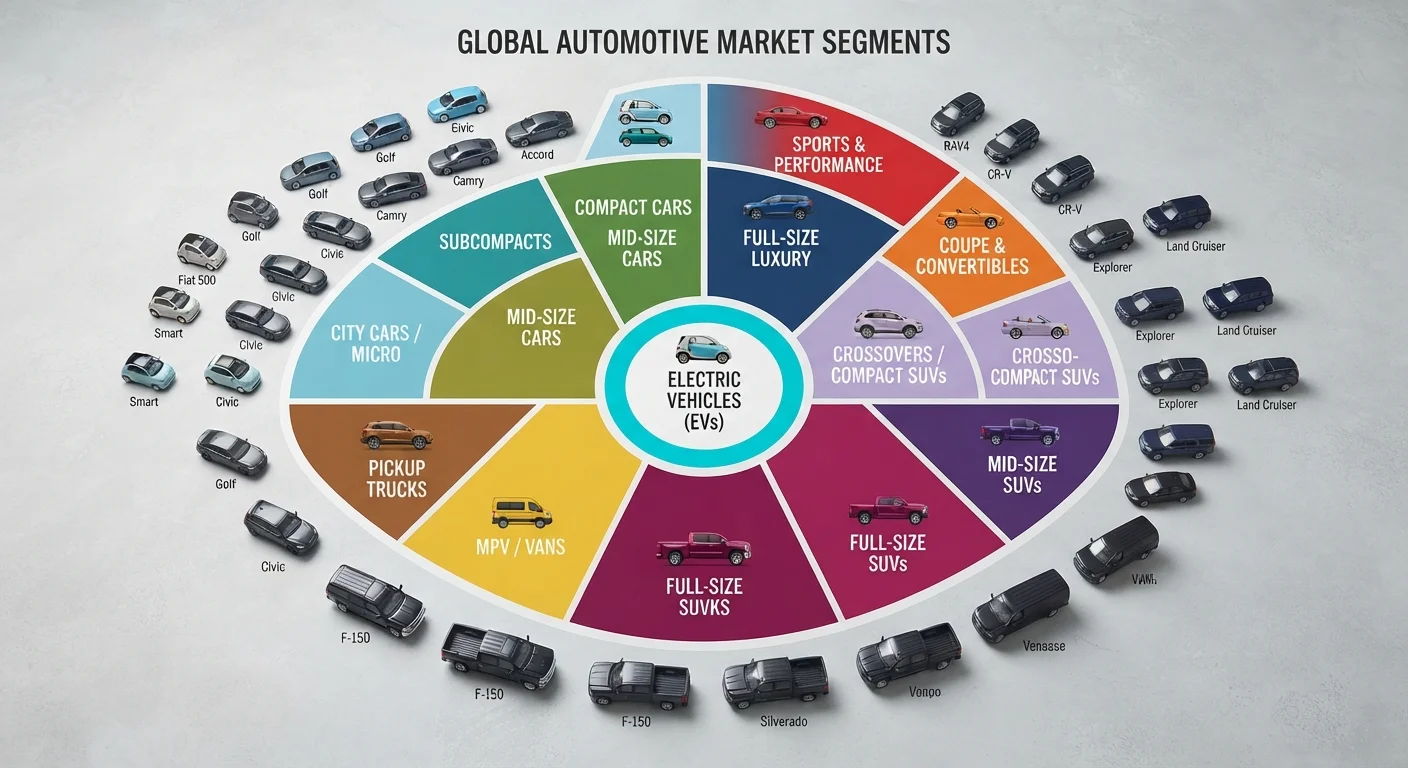
Walk into a dealership and ask for a "midsize" vehicle, and a salesperson might point you toward a sedan, an SUV, or even a pickup truck — all technically correct. The word carries different measurements depending on the vehicle category, and that inconsistency trips up a surprising number of shoppers.
Segments are classification tools used by automakers, analysts, and regulators to group vehicles by size, purpose, and price tier. They are not consumer-friendly nicknames. The EPA, for instance, classifies passenger cars by combined passenger and cargo volume in cubic feet — a number most buyers never see. Industry analysts like J.D. Power and Ward's use their own overlapping frameworks. The result is a system that is rigorous internally but opaque from the outside.
Understanding the gap between industry definitions and buyer assumptions is one of the most practical things you can do before shopping. For a foundational overview, the Vehicle Segments: A Complete Reference Guide covers every major class with typical dimensions and buyer fit.
Myth
A 'midsize' car is always bigger than a 'compact' car in every measurable way.
Fact
Size class labels are based on specific interior volume or wheelbase thresholds that can produce surprising overlaps as vehicles evolve.
Because segment thresholds were established years ago and vehicles have steadily grown — a phenomenon known as segment creep — some current compact cars exceed the interior dimensions of older midsize models. The label reflects where a vehicle fell when classified, not necessarily how it compares to every competitor today. Always compare actual specs: rear legroom, cargo volume, and wheelbase tell a more honest story than the segment name alone.
Myth
Luxury vehicles are just regular cars with extra features bolted on.
Fact
Luxury is a market tier defined by engineering investment, materials quality, and brand positioning — not merely an options package.
The differences between mainstream and luxury vehicles often begin at the engineering stage: suspension tuning for NVH reduction, higher-grade sound insulation, more refined powertrain calibration, and materials selected for tactile quality rather than cost efficiency. A well-equipped mainstream vehicle may match or exceed a base luxury model on feature count, yet the two remain in distinct segments because the underlying engineering investment differs. Price is a signal, not the definition.
Myth
"Crossover" is a vehicle segment, like compact or midsize.
Fact
Crossover is a body style describing a car-platform-based vehicle with SUV proportions; it exists across multiple size segments.
A crossover can be subcompact (think small urban utility vehicles), compact, midsize, or full-size. The term describes platform architecture and shape, not size or price tier. Conflating the two systems leads shoppers to compare vehicles that share only a name — not interior volume, towing capacity, or seating. Use body style and segment class together for an accurate picture of any vehicle.
Myth
If a vehicle is priced like a luxury car, it belongs to the luxury segment.
Fact
Segment classification is not determined by sticker price alone; brand positioning and engineering criteria both play a role.
A fully loaded mainstream truck or performance sedan can carry a price tag that overlaps with entry-level luxury models, yet analysts and manufacturers classify them in separate segments. Conversely, an entry-level trim from a luxury brand may undercut a loaded mainstream competitor on price. Segment membership reflects the manufacturer's brand tier and engineering approach, which is why price comparisons across segments require careful context.
Myth
Segment labels mean the same thing whether you're looking at sedans, SUVs, or trucks.
Fact
Size class definitions use different measurement criteria depending on vehicle type, so 'midsize' is not a universal standard.
The EPA defines passenger car classes primarily by combined interior volume. SUV segments are more loosely defined, drawing on wheelbase, row count, and cargo space. Pickup trucks use yet another framework, typically centered on payload and towing capacity alongside cab and bed configurations. Assuming a midsize SUV and a midsize sedan offer comparable interior space or utility because they share a label will almost certainly lead to disappointment.
Size Classes: What the Numbers Actually Say
Size labels — subcompact, compact, midsize, full-size — are among the most misread terms in automotive retail. Buyers frequently assume they signal absolute dimensions visible from the outside, but the measurements that define them are often interior-focused and vary by vehicle type.
For sedans, the EPA's classification hinges on combined interior volume (passenger space plus trunk). A car with 110 cubic feet of combined volume qualifies as midsize; 120 cubic feet pushes it into large-car territory. These thresholds were set decades ago and haven't kept pace with how vehicles have grown, which is why segment creep has quietly made many "compact" cars roomier than past midsize models.
For SUVs, size classes are based on a looser blend of wheelbase, cargo volume, and seating rows rather than a single EPA formula. That's why SUV segmentation deserves its own examination — the rules differ materially from sedans. For precise dimensional breakdowns, see Compact, Midsize, or Full-Size: What the Numbers Actually Mean.
110 cu ft
EPA midsize sedan interior volume threshold
The EPA classifies a passenger car as midsize when combined passenger and cargo volume reaches approximately 110 cubic feet, a threshold unchanged for decades.
2 systems
Overlapping classification frameworks buyers encounter
Shoppers routinely encounter both body style labels (crossover, sedan, truck) and size segment labels (compact, midsize, full-size) — two separate systems that do not map one-to-one.
Luxury as a Tier, Not a Feature List
Many buyers treat "luxury" as a synonym for a long options list — heated seats, a premium audio system, and ambient lighting. In segment terminology, luxury describes a market tier defined by brand positioning, engineering investment, and price band. It is layered on top of size classes, not separate from them.
An entry-luxury compact sedan and a mainstream midsize sedan may be nearly identical in exterior dimensions, yet they occupy entirely different segments. The distinctions involve materials sourcing, NVH (noise, vibration, and harshness) engineering, powertrain refinement, and the brand ecosystem — warranty support, loaner vehicles, dealer experience — rather than a specific feature checklist. Mainstream vs. Luxury Segments: What You're Actually Paying For explores exactly what engineering and brand differences justify the price gap.
Luxury itself is further subdivided. Entry-level luxury, mid-luxury, and ultra-luxury each carry different expectations around content and price. Where Luxury Fits in the Vehicle Segment Map walks through how those tiers are distinguished.
Don't Equate a Luxury Badge with Specific Features
Luxury segment membership does not guarantee any particular feature is included at every trim level. An entry-level trim from a luxury brand may lack adaptive cruise control, heated rear seats, or a large infotainment screen — all of which might appear on a loaded mainstream competitor. Always verify actual content against the specific trim you intend to purchase, not the brand's segment position. See how trim levels are structured for guidance on reading a lineup correctly.
Segments, Body Styles, and Why They're Not the Same Thing
One of the most persistent errors shoppers make is conflating segment with body style. A crossover is a body style — it describes a vehicle built on a car-type unibody platform with SUV-like proportions. It is not a segment. A crossover can be subcompact, compact, midsize, or full-size. Similarly, "compact" is a size segment, not a body style — a compact car and a compact crossover share a size class but are entirely different shapes.
The Segment vs. Body Style article untangles these two classification systems in detail. For a deeper look at body styles themselves, the Body Styles Guide covers sedans, SUVs, trucks, and every major shape. Understanding both systems simultaneously is what allows you to precisely target the right vehicle — not just "a midsize SUV" but a midsize, three-row, unibody crossover, for example.
If a segment label alone is guiding your search, you risk landing on a vehicle that technically qualifies but doesn't match your space or lifestyle needs. Reading a Segment Wrong: How It Leads to the Wrong Car details how this mismatch plays out and what to verify before committing.
Segment Name Is a Starting Point, Not a Guarantee
A segment label narrows the field — it does not confirm that a specific vehicle meets your space, capability, or comfort requirements. Two vehicles in the same segment can differ significantly in rear legroom, cargo volume, towing capacity, and ride quality. Use the segment to locate candidates, then verify the actual specifications of each model and trim before making a decision.