
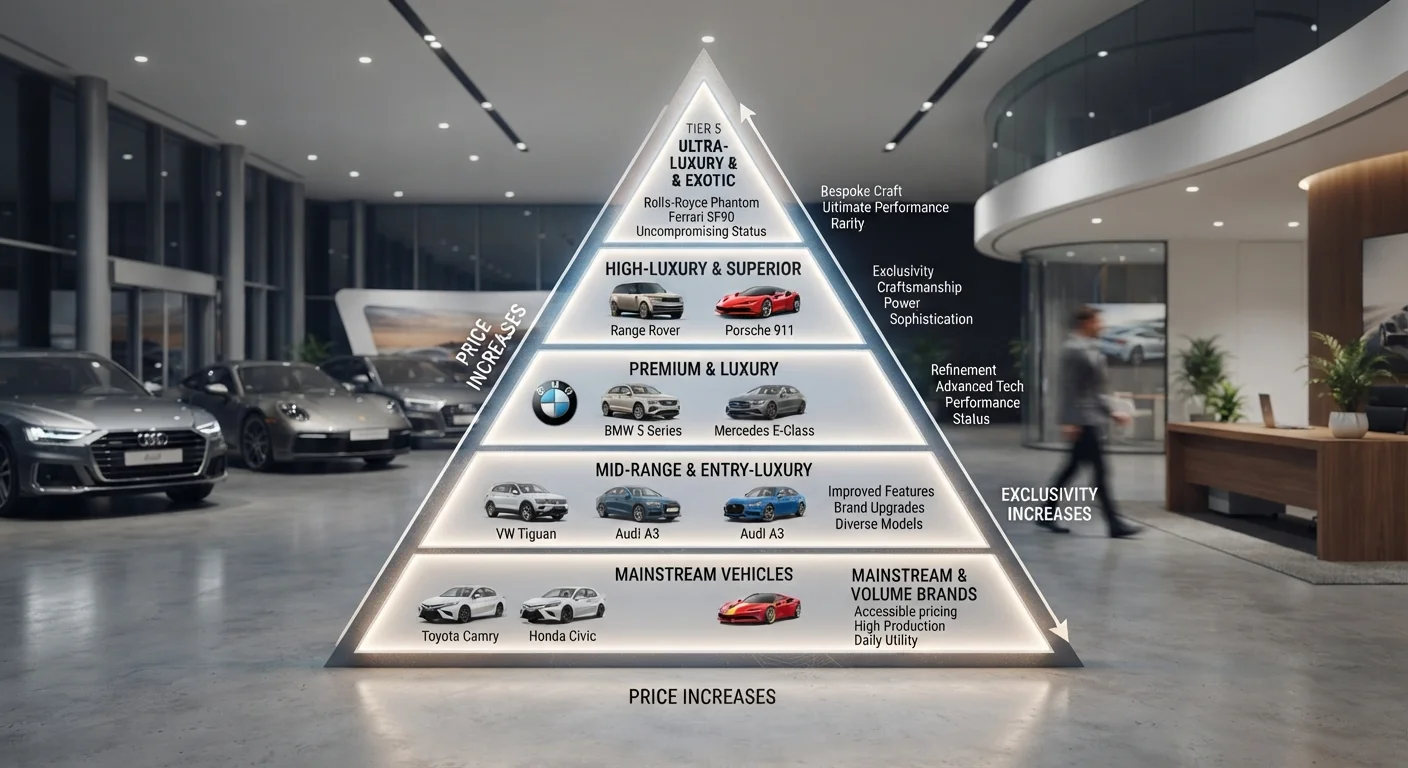
Two Independent Axes: Size and Class
Most car shoppers think of the market as a grid of body styles — sedans, SUVs, trucks. But the auto industry actually classifies vehicles along two separate axes: size (subcompact, compact, midsize, full-size) and class (mainstream or luxury). These axes are independent, which means a compact vehicle can be either a mainstream compact or a luxury compact, and a full-size SUV can sit in either tier.
Understanding this distinction prevents a very common shopping mistake: comparing a fully optioned mainstream midsize sedan directly against an entry-level luxury sedan, as though they belong to the same category. They share a similar price point, but they occupy different tiers of the market map. For a deeper look at how these classification systems interact, see how segments and body styles differ.
Luxury Tier ≠ A Specific Body Style
It's easy to assume luxury means sedan, or that SUVs are all mainstream. In practice, the luxury tier exists across every body style in the market. Luxury compact crossovers, luxury pickup variants, and luxury performance coupes all occupy the same broad tier despite having very different shapes and uses. The body styles guide covers how those shapes are defined separately from tier classification.
Mapping the Three Luxury Tiers
Within the luxury class, the industry informally recognizes three tiers based on price positioning, brand architecture, and content level:
- Entry-Level Luxury: The starting point for recognized luxury brands. Vehicles in this tier typically fall in the $35,000–$55,000 range (though price bands shift with inflation and market conditions). Buyers get meaningful upgrades in interior material quality, standard safety technology, and brand cachet over mainstream equivalents — but content is curated rather than comprehensive.
- Mid-Luxury: Larger vehicles or higher-specification models within luxury brands, generally spanning $55,000–$100,000. This tier is where powertrain sophistication, ride isolation engineering, and interior architecture begin to distinguish sharply from mainstream alternatives.
- Ultra-Luxury: The top tier, defined as much by exclusivity and bespoke craftsmanship as by price. Vehicles here are often produced in limited volumes, feature hand-finished interiors, and carry prices well above $100,000. Some are built nearly entirely to customer specification.
For a full breakdown of what buyers are actually paying for when they cross into luxury, see what separates mainstream from luxury segments.
~18%
Luxury vehicles' share of U.S. new car sales
Industry tracking data has consistently shown luxury vehicles representing roughly 15–20% of annual U.S. new vehicle sales volume in recent years.
$55,000+
Typical mid-luxury vehicle price floor
Mid-luxury pricing thresholds are approximate and shift with market conditions; this figure reflects general industry convention rather than a fixed standard.
Where Entry-Level Luxury Creates Confusion
The entry-level luxury tier is where the most buyer confusion lives. A top-spec mainstream compact sedan and an entry-level luxury compact sedan can carry nearly identical transaction prices. What differs is brand positioning, residual value trajectory, standard content structure, and — in many cases — the dealership experience itself.
It's also worth noting that mainstream brands frequently use premium trim names that sound luxurious without placing the vehicle in the luxury tier. Words like "Platinum," "Premier," or "Limited" describe trim level positioning within a mainstream lineup, not segment classification. A vehicle's segment tier is determined by the brand architecture it belongs to, not by what a trim badge says.
Check the Brand Tier, Not Just the Badge
When evaluating whether a vehicle is truly luxury, look at the brand family it belongs to rather than individual trim names. Mainstream brands use premium-sounding trim labels regularly. Confirming whether a vehicle belongs to a dedicated luxury brand — or a luxury sub-brand with separate dealerships and distinct engineering — is the cleaner way to identify its tier.
Luxury Across Body Styles and the Full Segment Map
Because luxury is a tier rather than a body style, it overlays the entire vehicle segment map. Luxury sedans, luxury compact SUVs, luxury midsize SUVs, and luxury pickup variants all exist. This is why a complete picture of the market requires understanding both axes simultaneously.
The vehicle segments reference guide maps out size classes across body styles. When you add the luxury tier on top of that grid, you get the full market structure: every cell in the size-by-body-style grid can potentially contain both a mainstream and a luxury variant. SUV shoppers, in particular, encounter this frequently — for more on how SUV size classes work independently of tier, see how SUVs are segmented by size.
Keeping size and class separate in your mental model makes it easier to identify which vehicles you're actually comparing and whether a price difference reflects a size upgrade, a tier upgrade, or simply a content package difference.
“Segment classification is fundamentally about where a vehicle sits in the competitive set — the price band, the brand promise, and the buyer expectation — not about any single feature it includes or excludes.”
— Car Types Explained Editorial Team, Automotive content specialists