
How the Market Divides Into Segments
The US auto market is organized into a tiered structure that reflects both vehicle size and intended buyer. At the base are mainstream segments — subcompact, compact, midsize, and full-size classes — designed around broad accessibility. Above them sit luxury segments, which layer premium positioning on top of comparable body styles. A luxury midsize sedan and a mainstream midsize sedan occupy the same size class but entirely different market tiers.
Understanding this structure matters because segment placement shapes everything: how a vehicle is engineered, what materials are used inside, what technology comes standard, and how manufacturers calculate their margins. Industry segment definitions frequently diverge from what buyers assume, so it's worth approaching the map with clear eyes.
| Criterion | Mainstream Segment | Luxury Segment |
|---|---|---|
| Typical price range | ~$20,000–$45,000 | ~$40,000–$150,000+ |
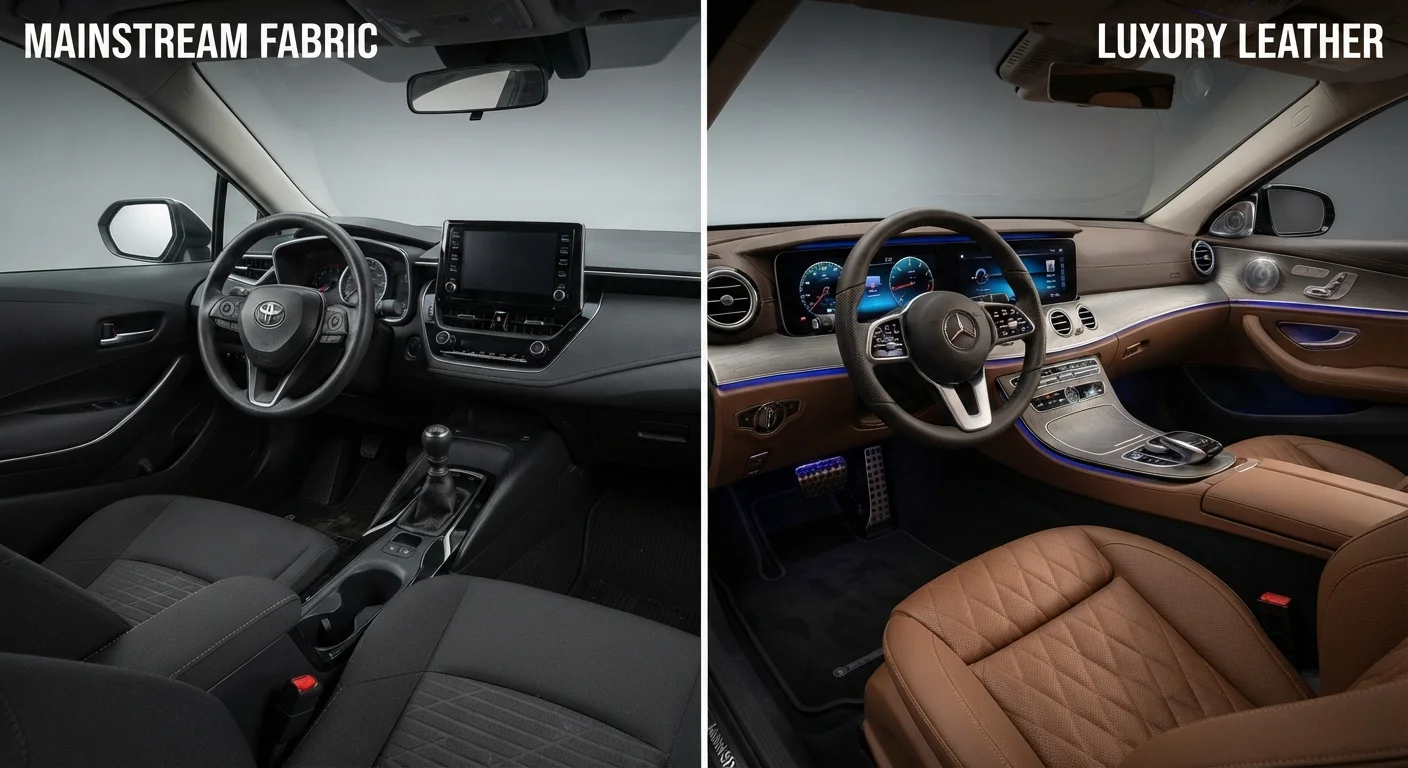
| Interior materials | Soft-touch plastics, cloth/entry leather | Genuine leather, wood, aluminum, premium stitching |
| NVH refinement | Moderate sound insulation | Extensive multi-layer insulation |
| Technology availability | Safety tech now broad; advanced features limited | Advanced features standard or widely available |
| Depreciation rate | Generally slower percentage drop | Often steeper, especially entry luxury |
| Maintenance costs | Lower; broader service network | Higher; often brand-specific service required |
| Customization options | Limited packages and colors | Extensive bespoke options and configurations |
What the Price Premium Actually Buys
The cost difference between a mainstream and a luxury vehicle in the same body style is rarely explained by a single factor. It reflects a stack of compounding investments.
Engineering and NVH Refinement
NVH — the collective term for unwanted sounds and sensations inside the cabin — is where luxury vehicles invest heavily. Additional sound-deadening material, stiffer body structures, and more precisely tuned suspension components all reduce the intrusions that mainstream vehicles accept as normal trade-offs. The result is a quieter, more composed ride that is difficult to fully appreciate until you experience it directly.
Materials and Interior Quality
Mainstream interiors increasingly use soft-touch plastics and genuine cloth upholstery. Luxury interiors substitute genuine leather, open-pore wood, aluminum, or hand-stitched surfaces in areas where the driver and passengers actually touch. These aren't just aesthetic — they affect how surfaces wear over time and how the cabin feels on a long drive.
Technology Sequencing
Many driver assistance and infotainment features now appear across both tiers, but luxury brands have historically introduced them first and implemented them more comprehensively. Adaptive air suspension, head-up displays, and massaging seats, for example, are still largely confined to luxury and near-luxury models. Trim level structures explain some of this — features can trickle down over model cycles.
~49%
Average luxury vehicle depreciation over 5 years
Industry data from vehicle valuation analysts consistently shows luxury vehicles losing roughly half their value within five years, compared to lower rates for many mainstream models.
2–3x
Typical maintenance cost multiplier for luxury vs. mainstream
Consumer cost analyses suggest luxury vehicle owners often pay two to three times more annually for scheduled maintenance than mainstream vehicle owners in equivalent segments.
~$13,000
Average price gap between entry luxury and upper mainstream sedans
Market pricing data indicates the average transaction price difference between comparable mainstream and entry-luxury midsize sedans has historically ranged from $10,000 to $15,000.
Where Mainstream Vehicles Have Caught Up
The technology gap is narrowing. Automatic emergency braking, lane-keep assist, and large touchscreen infotainment systems are now standard or widely available on mainstream models. In reliability rankings compiled by consumer research organizations, mainstream brands have consistently performed competitively — and in some years, outperformed luxury counterparts whose more complex systems introduce more potential failure points.
For buyers whose priority is dependable transportation with contemporary features, a well-equipped mainstream vehicle may satisfy most needs. The honest question is whether the refinement difference — which is real — is worth the ownership cost premium in your specific context. Buying at the top of a segment within the mainstream tier sometimes delivers near-luxury levels of equipment at a lower base price.
Total Cost of Ownership: The Full Picture
Sticker price is the starting point, not the ending point. Luxury vehicles typically carry higher insurance premiums, more expensive scheduled maintenance (often tied to brand-authorized service centers), and costlier parts. Depreciation also tends to accelerate more sharply in the luxury tier — particularly in the entry-luxury category, where supply has historically exceeded demand.
Understanding how dealers price vehicles is useful context here, since luxury brands often maintain tighter control over dealer margins and discount behavior than mainstream brands. For a complete ownership cost picture, factor in projected maintenance intervals, insurance quotes for your driver profile, and historical resale data for the specific model you're considering. Where luxury fits in the broader segment map provides additional context on how the luxury tier itself is subdivided — entry, mid-luxury, and ultra-luxury each carry different cost dynamics.
The Blurring Line at the Segment Boundary
The boundary between upper mainstream and entry luxury has become increasingly indistinct. Some mainstream brands now offer near-luxury trim levels with leather, panoramic roofs, and advanced driver assistance packages that rival entry-luxury competitors on features. Conversely, some entry-luxury models are built on shared platforms with mainstream siblings. Evaluating specific models on their actual content — rather than relying solely on brand tier — is the more reliable approach for buyers in this price range.