
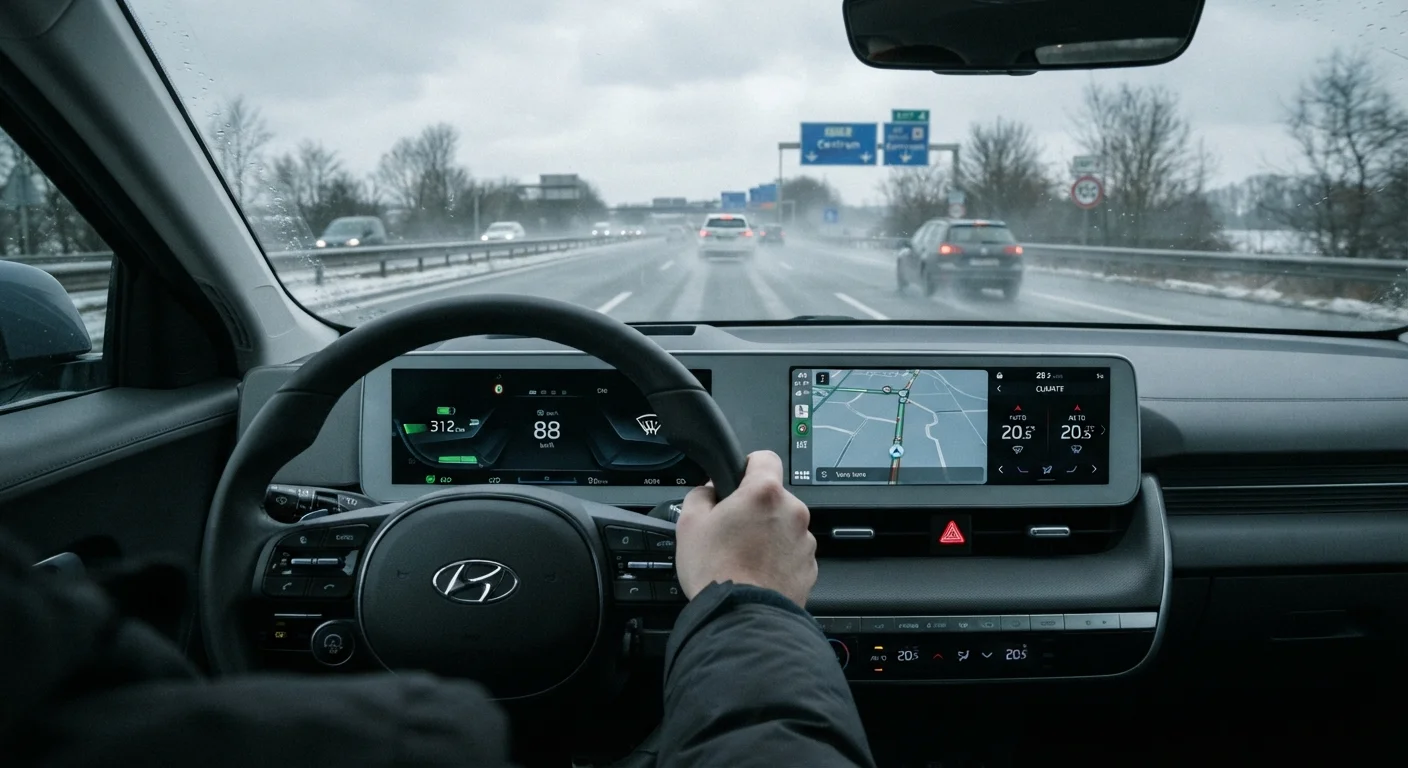
Why EPA Range Is Only a Starting Point
Every new EV carries an EPA-estimated range on its window sticker — a number tested under controlled laboratory conditions. That figure is a useful baseline for comparison shopping, but it rarely reflects what you'll see on your dashboard. As our guide to window sticker range figures explains, the gap between advertised and real-world range is predictable once you understand what drives it.
The factors below are the primary culprits. None of them are failures of the technology — they reflect the physics of moving a vehicle and maintaining cabin comfort. Knowing how each one works gives you the tools to plan realistic trips and charge with confidence.
Range Figures and Individual Results
EPA range estimates are a standardized comparison tool, not a guarantee of what any individual driver will achieve. Real-world results vary based on driving habits, geography, climate, and vehicle condition. If you frequently see a consistent gap between rated and actual range, our article on why claimed EV range rarely matches experience explains the underlying reasons in detail.
Key Factors That Reduce Real-World Range
Ambient Temperature
Cold weather is the most impactful range variable most drivers encounter. Lithium-ion batteries operate less efficiently at low temperatures — internal resistance rises, reducing the energy the pack can deliver. The U.S. Department of Energy has noted that EV range can drop by roughly 20–40% in very cold conditions, depending on the vehicle and how the cabin heat is managed.
Heat also takes a toll, though less severely in most climates. Batteries operating above their optimal thermal range draw on the vehicle's battery thermal management system, which itself consumes energy. Pre-conditioning the cabin while still plugged in at home is one of the most effective ways to limit cold-weather range loss on any given day.
Cold weather can cut EV range by 20–40%, making pre-conditioning while plugged in one of the most effective mitigations.
Driving Speed
Aerodynamic drag increases with the square of vehicle speed — meaning that driving at 75 mph demands roughly 56% more energy to overcome air resistance than driving at 55 mph. This is why EPA range estimates, which blend city and highway cycles, often overstate real highway performance for many EVs.
For drivers whose commutes or road trips involve sustained highway speeds, budgeting 10–20% below the EPA figure is a reasonable planning habit. Slowing down modestly on long interstate legs can meaningfully extend the distance between charging stops without adding significant time to the journey.
Driving at 75 mph instead of 55 mph can increase energy demand by more than 50% due to aerodynamic drag.
Climate Control Use
Heating a cabin in an EV is energy-intensive because most EVs use electric resistance heat — essentially the same principle as a space heater — rather than recovering waste heat from an engine. On a 20°F day, cabin heating alone can account for 30–40% of total energy consumption on a short trip.
Newer EVs increasingly use heat pump systems, which are significantly more efficient than resistance heating, though they also lose efficiency at very low temperatures. Air conditioning draws less power than resistance heat, but sustained use on hot days still trims real-world range by a noticeable margin. Seat and steering wheel heaters are far more efficient ways to stay warm than heating the entire cabin volume.
Electric resistance cabin heating can account for 30–40% of total energy use on a cold short-distance trip.
Vehicle Load and Payload
Every additional pound in the vehicle requires more energy to accelerate and maintain speed. Passengers, cargo, roof racks, and tow loads all reduce efficiency. Towing deserves special attention: pulling a trailer dramatically increases aerodynamic drag and rolling resistance simultaneously, and can reduce range by 40–50% or more depending on the load and speed.
For everyday driving, the effect of a full passenger load is modest but measurable — typically a few percentage points of range. Roof-mounted cargo carriers add both weight and drag, and can reduce highway range meaningfully even when empty due to their aerodynamic impact.
Towing a trailer can cut EV range by 40–50% or more — a factor critical to planning road trips with cargo.
Driving Style and Terrain
Aggressive acceleration depletes the battery faster than smooth, gradual inputs. Regenerative braking — which recovers kinetic energy back into the battery during deceleration — partially offsets this, but it cannot recapture all energy lost through hard acceleration. Urban driving with frequent stops and starts tends to be kinder to range than highway driving for most EVs, precisely because regeneration opportunities are more frequent.
Hilly or mountainous terrain creates similar dynamics. Climbing requires more energy; descending recovers some through regeneration. Net range impact depends on the grade and vehicle, but drivers moving from flat to hilly routes should expect a reduction. Anticipating terrain and speed changes — lifting off the accelerator early rather than braking — maximizes regenerative recovery and extends range on any route.
Smooth, anticipatory driving maximizes regenerative braking recovery and is one of the easiest ways to extend range.
Pre-Condition Before You Unplug
Using your EV's scheduled pre-conditioning feature to warm or cool the cabin while the vehicle is still connected to a charger means the battery starts the trip at full capacity rather than depleted by climate control. Most EV apps and in-car systems support scheduled departure times. This single habit can recover several miles of cold-weather range on typical winter commutes.
Using This Knowledge Day to Day
Understanding range variables doesn't require engineering expertise — it requires honest self-assessment of how and where you drive. A commuter making short urban hops in a mild climate will consistently exceed EPA estimates. A driver regularly covering interstate miles in a cold northern winter should expect to budget considerably less range per charge.
These dynamics also connect to ownership costs. Over-reliance on DC fast charging to compensate for range shortfalls, for instance, can increase per-mile energy costs noticeably. The Charging & Costs hub covers those tradeoffs in depth. Longer-term, battery capacity itself gradually diminishes — a separate but related variable covered in our guide to battery degradation and long-term range loss.
Matching an EV to your actual driving patterns — rather than its peak EPA number — is the most reliable path to daily satisfaction with the technology.