
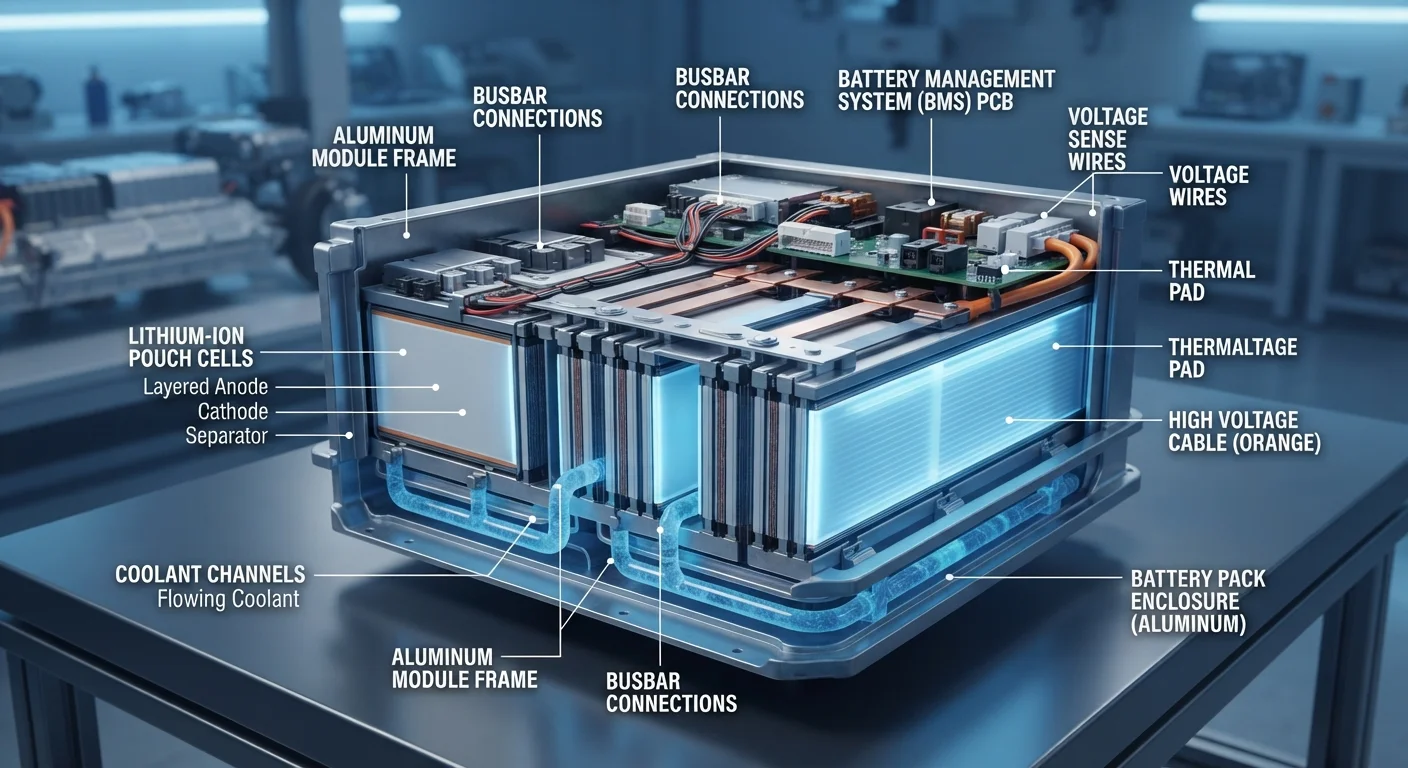
What Happens Inside the Battery as It Ages
Every lithium-ion battery — whether in a smartphone or an electric vehicle — degrades through the same underlying chemistry. As the battery cycles through charges and discharges, lithium ions move between electrodes. Over time, some of those ions become permanently trapped, reducing the number available to carry charge. The result is a measurable drop in the battery's total capacity.
In EVs, a battery management system (BMS) actively monitors cell temperatures, voltage, and current to keep the pack operating within safe limits. This protective layer slows degradation meaningfully, which is why EV batteries typically outlast consumer electronics batteries by many years. Still, no engineering solution eliminates the process entirely — it slows it.
For a practical understanding of how these factors interact in daily driving, see how real-world conditions shape EV range.
~2.3%
Average annual capacity loss per year
Aggregated real-world fleet data from multiple studies suggests most EV batteries lose roughly 1–3% of capacity annually under typical driving and charging conditions.
8 years / 100K mi
Minimum federal battery warranty requirement
U.S. federal regulations require EV manufacturers to warrant battery packs for at least 8 years or 100,000 miles, whichever comes first.
~37 miles
Average daily driving distance in the U.S.
According to Federal Highway Administration data, the average American drives approximately 37 miles per day — well within the range of even significantly degraded EV batteries.
Key Factors That Speed Up or Slow Down Degradation
Not all EV batteries age at the same rate. Several controllable and environmental factors influence the pace of degradation:
- Charging habits: Regularly charging to 100% and allowing the battery to sit fully charged for extended periods places stress on cells. Most manufacturers recommend a daily charge ceiling of 80% for routine use.
- DC fast charging frequency: High-current fast charging generates heat and pushes electrons through cells rapidly. Occasional use is fine; making it a daily habit compounds wear over time.
- Temperature exposure: Heat is the single greatest accelerant of chemical aging in lithium-ion cells. Vehicles regularly parked outdoors in hot climates degrade faster than those in moderate-temperature regions.
- Depth of discharge: Frequently running the battery very low before recharging also stresses cells. Keeping charge between roughly 20% and 80% is widely considered the longevity sweet spot.
Simple Habits That Protect Battery Health
Set your daily charge limit to around 80% using your vehicle's built-in charging settings — most EVs make this straightforward. Reserve full 100% charges for days when you genuinely need maximum range. When possible, plug into a Level 2 home charger rather than relying on DC fast chargers for everyday top-ups. These habits compound over years to meaningfully slow capacity loss.
What to Realistically Expect After Several Years
Large-scale fleet data and manufacturer disclosures paint a broadly reassuring picture. Analysis of real-world EV usage — including data from vehicles with over 100,000 miles — consistently shows average capacity retention in the 75–85% range after many years of use. A vehicle with an original EPA-rated range of 280 miles might deliver roughly 220–240 miles after a decade of typical ownership.
This gradual reduction is unlikely to affect daily commuters dramatically — the average U.S. driver covers around 37 miles per day, well within the range of even a moderately degraded EV battery. Long-distance road trips may require more planning over time, but for most buyers, the practical impact is modest.
It is worth noting that degradation tends to be slower than many buyers fear, and many of the most alarming claims about EV batteries simply do not hold up to scrutiny. For a broader look at which EV concerns are fact versus fiction, see common EV myths and the evidence behind them.
“Lithium-ion batteries in well-managed electric vehicles are proving far more durable than early skeptics predicted. The data from vehicles on the road today consistently shows that most packs retain the majority of their capacity well past the 100,000-mile mark.”
— EV & Hybrid Guide Editorial Team, Synthesizing published fleet data and manufacturer disclosures on EV battery longevity
Financial Implications: Resale Value and Ownership Costs
Battery degradation has a direct bearing on an EV's resale value. A used EV with documented battery health — some manufacturers provide this through in-app diagnostics — commands more buyer confidence than one without. Vehicles showing significant capacity loss will typically be priced lower on the used market to reflect reduced range.
This dynamic is one of several reasons EV depreciation behaves differently from combustion vehicles. Battery age, remaining warranty coverage, and range anxiety among used-car buyers all factor into how quickly an EV loses value. Understanding this helps buyers evaluate total cost of ownership more accurately — a topic explored in depth in our five-year EV cost breakdown.
When evaluating a used EV purchase, requesting a battery health report and verifying remaining warranty coverage are reasonable due-diligence steps. Federal warranty minimums — 8 years or 100,000 miles — provide a baseline of protection, though individual policies vary in what capacity threshold triggers a covered repair or replacement.
This article is for general informational purposes only and does not constitute financial or purchasing advice. Actual battery performance, degradation rates, and warranty terms vary by manufacturer, model, and individual usage conditions. Consult the vehicle manufacturer's documentation and a qualified advisor for decisions specific to your situation.