
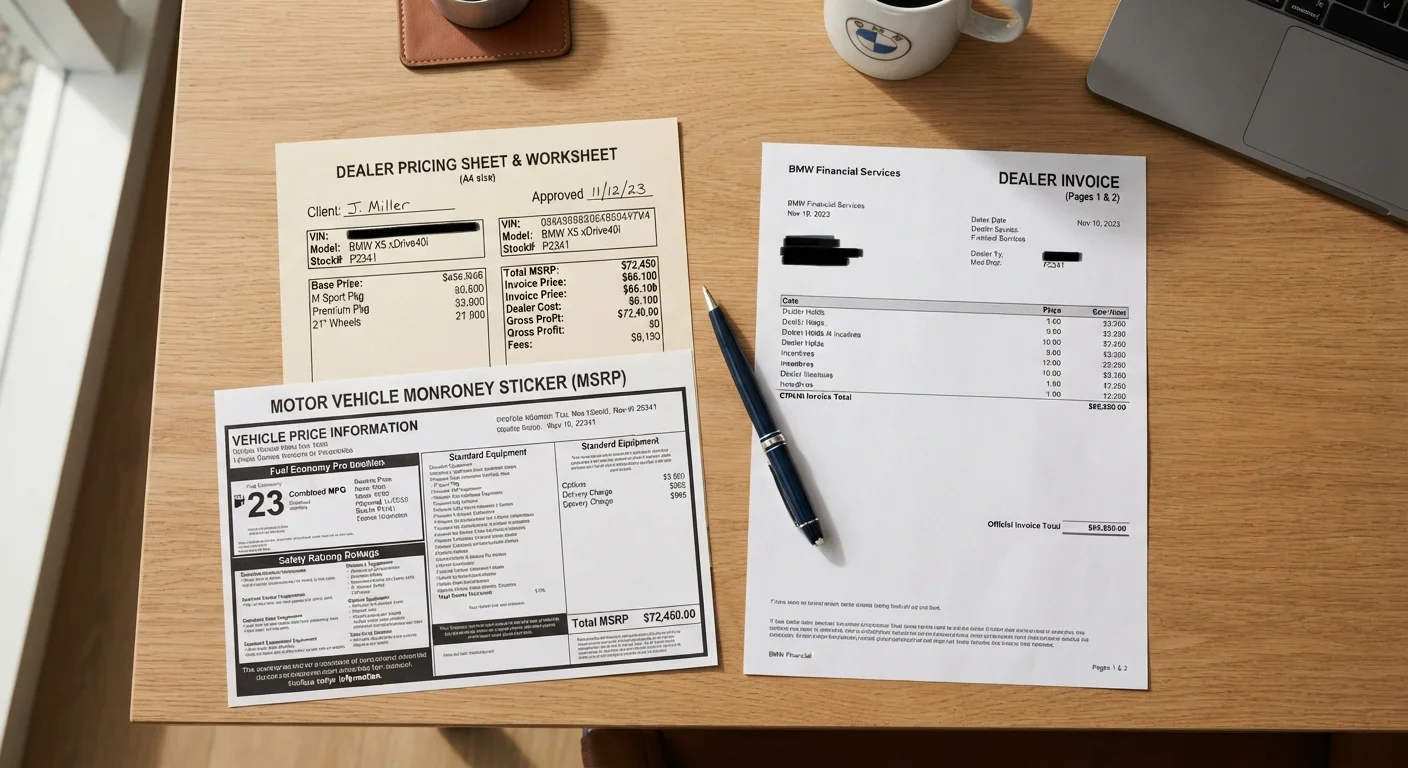
The Price Journey: An Overview
A new vehicle's price doesn't spring into existence on a window sticker. It accumulates in layers — manufacturer production costs, wholesale pricing to dealers, retail markup, incentives flowing in the opposite direction, and a final layer of fees added at the point of sale. Each layer represents either a margin or an adjustment, and most of them are at least partially visible to informed buyers.
Think of the pricing structure as a stack: the manufacturer sets a floor (invoice), suggests a ceiling (MSRP), then pulls the ceiling down selectively with rebates and incentives. Dealers add back-end costs that push the actual contract number up again. Understanding where each number comes from — and who controls it — is the foundation of effective negotiation. For a deep dive into the core terms, see Invoice Price, MSRP, and Dealer Cost: What Each Number Actually Means.
Factory Invoice and Manufacturer Cost
The factory invoice is the amount the manufacturer bills the dealership when the vehicle is delivered. It includes the base vehicle price, factory-installed options, and the destination charge. It is a real document, and buyers can often request to see it.
What the invoice does not represent is the dealer's true net cost. Two mechanisms reduce what the dealer actually pays below invoice level:
- Holdback: A periodic payment from the manufacturer back to the dealer — typically a percentage of MSRP — that reimburses carrying costs. The dealer collects this regardless of what price the vehicle sells for.
- Dealer cash (unadvertised incentives): Manufacturer-to-dealer payments tied to specific models, regions, or sales periods. These are separate from consumer rebates and are not always disclosed to buyers.
This means a dealer can sell at or even slightly below invoice and still generate a profit. Invoice is a useful reference point, not a cost floor. For context on how these numbers compare, the Car Pricing Glossary defines each term precisely.
MSRP and the Window Sticker
The Manufacturer's Suggested Retail Price (MSRP) is the manufacturer's recommended selling price, broken into base price, option packages, and destination charge on the Monroney sticker (the federally required window label). It is a suggestion — not a legal maximum or minimum.
In a balanced market, most transactions close below MSRP. In a supply-constrained market, dealers may add an Addendum to Dealer Markup (ADM) — a secondary sticker that increases the asking price above MSRP. ADMs are legal but negotiable; some buyers successfully remove them, particularly when inventory levels normalize.
The window sticker also itemizes every factory-installed package, which matters when evaluating whether optional packages add value for your specific use case or simply inflate the price. If you're considering ordering a vehicle to control exactly what options you pay for, see Ordering vs. Buying Off the Lot.
Hidden Margins: Holdback, Incentives, and Dealer Cash
The gap between what a dealer pays and what you see on a sticker is wider than most buyers realize. Three mechanisms create invisible margin:
- Holdback
- Returned to the dealer after the sale. It effectively lowers the dealer's cost below invoice retroactively. See the note below for how to interpret published estimates.
- Consumer incentives (rebates)
- Manufacturer-to-buyer cash payments that reduce your out-of-pocket cost. These are public, model-specific, and sometimes stackable with financing offers. They do not reduce the dealer's invoice cost.
- Dealer cash
- Manufacturer-to-dealer payments on slow-moving inventory. Unlike rebates, these don't automatically pass through to you — the dealer may pocket them unless you've negotiated a price that already accounts for reduced demand on that model.
Identifying which incentives apply to your transaction before you start negotiating gives you clarity on what the effective floor price really is. For a full breakdown of how to build that picture, see The Complete Guide to Negotiating a Car at a Dealership.
Fees, Add-Ons, and Back-End Costs
Once you agree on a selling price, the contract is not yet finalized. A second category of costs appears at the finance and insurance (F&I) office stage:
- Documentation fee: A dealer charge for processing paperwork. Amounts vary widely by state — some states cap it, others don't. It is partially negotiable depending on local norms.
- Dealer-installed accessories: Items like floor mats, window tinting, or paint sealant added to lot vehicles. These are frequently pre-installed and presented as required, but you can often negotiate their removal or price reduction.
- Extended warranties and protection products: Optional products sold in the F&I office. These carry significant markup and are almost always available later through third parties if desired.
- Government fees: Title, registration, and sales tax are non-negotiable and vary by state and locality.
Separating negotiable dealer fees from fixed government fees before you sit down at the F&I office prevents the two categories from being blurred together in ways that obscure actual costs.
How the Final Transaction Price Is Set
The number that actually appears on your signed contract — the transaction price — is the product of everything above: agreed selling price, minus applicable consumer rebates, plus non-negotiable fees (destination, taxes, title, registration), plus any dealer fees and add-ons you accepted.
In practice, buyers who understand the full map — invoice as a reference, MSRP as a ceiling, holdback as a buffer, and fees as a separate negotiation — are far better positioned to evaluate whether a quoted deal is fair. Published transaction data aggregated across real buyers in your region is the most useful benchmark, because it reflects what the market is actually clearing at, not just what manufacturers and dealers publish.
For a step-by-step framework covering research, pricing, and the dealership visit itself, see Car Negotiation from Start to Finish: A Complete Buyer's Roadmap and explore the broader context of Buying New Cars for what new-vehicle purchases involve overall.
This article is for general educational purposes only and does not constitute financial, legal, or purchasing advice. Pricing structures, fees, and incentive programs vary by manufacturer, region, and market conditions. Consult a qualified professional and conduct your own research before making any vehicle purchase decision.