
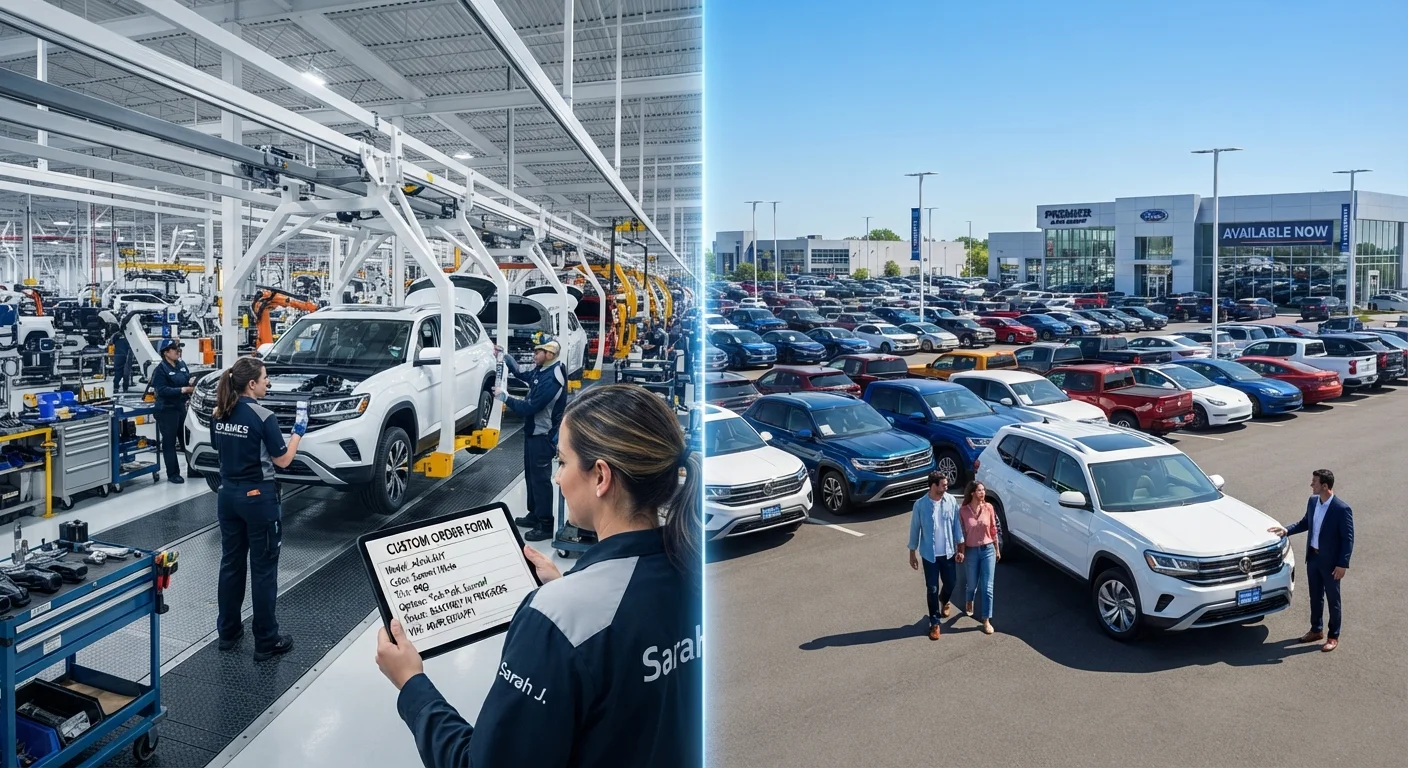
How Factory Orders Actually Work
A factory order — sometimes called a custom order or build order — means you configure the vehicle with the dealer, who submits that specification directly to the manufacturer's production queue. You're not buying anything sitting on a lot; you're reserving a production slot.
The process typically runs as follows: you and the dealer finalize a build sheet (trim level, powertrain, color, option packages), the dealer submits the order, the manufacturer assigns a production window, and the vehicle is shipped to the dealer once built. Total elapsed time varies by manufacturer and model, but six to twelve weeks is a common range. Some high-demand models run longer.
Pricing on a factory order is generally negotiated at the time of the order, not at delivery — which matters. If manufacturer incentives or rebates change between order and delivery, the terms that apply can depend on how the deal was structured. Get that in writing. For a closer look at how that price evolves from invoice to contract, see how new car pricing is built.
A deposit is usually required to place the order. Confirm whether it's refundable and under what conditions before signing anything.
| Criterion | Factory Order | Buying Off the Lot |
|---|---|---|
| Time to ownership | 6–12+ weeks typical | Same day to a few days |
| Configuration control | Full — every option selected | Limited to available stock |
| Deposit required | Usually yes — confirm if refundable | Typically no upfront deposit |
| Pricing leverage | Varies by demand and dealer | Varies; can discount aging stock |
| Risk of unwanted add-ons | Lower — build sheet is agreed upfront | Higher — pre-installed extras common |
| Financing timing | Can be arranged before delivery | Arranged at point of sale |
| Model-year incentive exposure | Can lock in early; terms vary | Captured at time of purchase |
How Buying Off the Lot Works
When you buy off the lot, you're purchasing a vehicle the dealer already owns — it was built to a forecast of what buyers would want and shipped to the dealership without a specific customer in mind. What you see in the lot is what's available today.
The process is faster by design: you test drive, negotiate, arrange financing, and potentially drive away the same day. That immediacy has real value for buyers with time constraints.
The tradeoff is selection. Lot vehicles come pre-configured with whatever packages and colors the dealer ordered. If every unit on the lot has an option bundle you don't want, you'll pay for those features regardless. It's worth checking whether the listed price reflects add-ons that have been bolted on after arrival — dealer-installed accessories, protective coatings, or similar items that inflate the out-the-door price. Understanding how to approach deals when selection is limited can help you work within these constraints more effectively.
Financing is also arranged in the moment. If you haven't already secured a pre-approval, you'll be presented with dealer financing options at the point of sale. It pays to understand your alternatives in advance — see how dealer financing compares to a bank loan before you sit at the finance desk.
The Real Tradeoffs: Time, Specification, and Price
The core tension between these two paths comes down to three variables: how much time you can afford to wait, how precisely you need the vehicle configured, and how much pricing flexibility exists in your market.
6–12 weeks
Typical factory order lead time
Lead times vary significantly by manufacturer, model popularity, and production scheduling — some orders have run longer during periods of supply disruption.
~20%
New vehicles sold via factory order (U.S. estimate)
Industry observers have estimated that roughly one in five new vehicle purchases in the U.S. involves some form of custom or factory order, though this varies by brand.
Time: Lot purchases close in hours or days. Factory orders close in weeks or months. If your current vehicle is unreliable or a lease is expiring, that gap is often the deciding factor.
Specification: A factory order is the only path that guarantees your exact build. Lot shopping can be expanded by searching dealer inventories regionally or requesting dealer trades, but that adds complexity and isn't always successful for less-common configurations.
Price: Neither path is automatically cheaper. In high-demand markets, lot vehicles sometimes carry markups above MSRP (manufacturer's suggested retail price). Factory orders can occasionally avoid those premiums, but dealer policies vary — and some dealers apply markups to orders too. In softer markets, lot vehicles may be discounted to move aging inventory, which orders won't capture.
If you're weighing how to structure the financial side of either purchase, it's worth reviewing your loan options separately from the dealer conversation. Comparing dealer financing to bank and credit union loans lays out what each route typically involves.