
The Three Tiers Where Incentive Money Moves
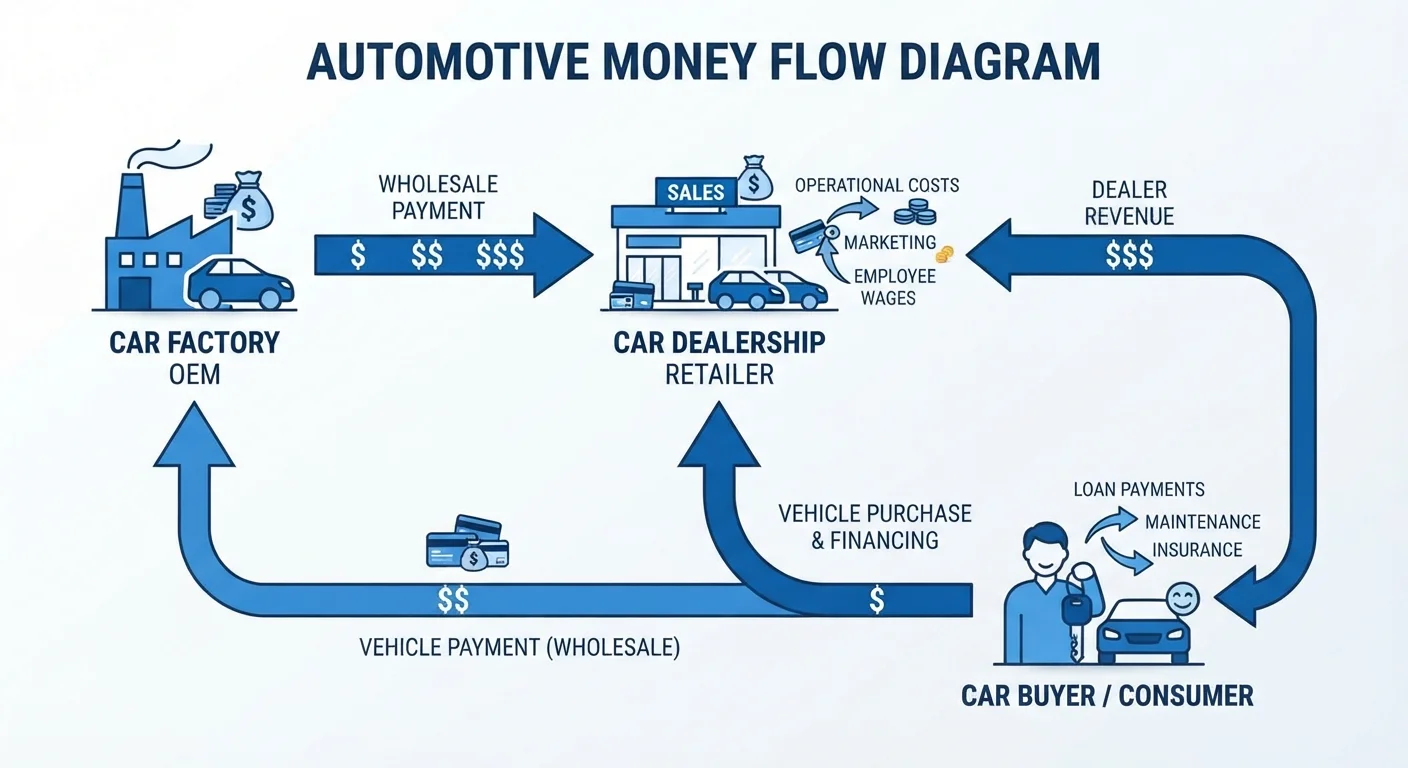
When an automaker needs to move inventory, it doesn't just drop the price — it routes money strategically through three distinct tiers: the factory, the dealer, and the consumer. Understanding which tier an incentive targets tells you a great deal about whether that money actually lands in your pocket.
At the factory level, manufacturers set the base invoice price — what the dealer nominally pays for the vehicle. Embedded within that structure is holdback, a percentage of MSRP (commonly 2–3%) that the manufacturer pays back to the dealer after the sale. Holdback is built into invoice pricing and is not separately disclosed. See why invoice price isn't the dealer's true cost for the full picture on how these backend payments work.
At the dealer level, manufacturers may layer on dealer cash — a separate, undisclosed payment made to encourage dealers to move specific units. This is distinct from holdback and is often used to clear aging inventory or hit regional sales targets.
At the consumer level, manufacturers offer programs that flow directly to buyers: cash rebates, loyalty bonuses, conquest cash for defectors from other brands, and subvented financing. These are the incentives most buyers are aware of — but they represent only one slice of the full incentive stack. For a broader breakdown of how these types differ from one another, car incentives decoded covers each category in detail.
2–3%
Typical holdback as a percentage of MSRP
Holdback percentages vary by manufacturer but commonly fall in this range, representing several hundred to over a thousand dollars on most new vehicles.
$3,000+
Average consumer incentive per unit (industry estimate)
Industry analysts tracking automotive incentive spending have historically estimated average per-vehicle consumer incentive values in this range during periods of normal inventory, though figures shift significantly with supply conditions.
Either/Or
Cash rebate vs. low-APR offer structure
Manufacturers typically require buyers to choose between a cash rebate and a subvented financing rate on the same vehicle — combining both on one deal is generally not permitted.
How Consumer Rebates Actually Work
Consumer rebates — often called factory cash or cash-back offers — are funded by the manufacturer and applied at the point of sale. They appear as a line item on your purchase contract, reducing the capitalized cost (on a lease) or the financed amount (on a purchase). The dealer does not absorb this money; the manufacturer reimburses the dealership separately.
Eligibility conditions matter. Some rebates are universal; others are targeted. Loyalty rebates require documented prior ownership of a vehicle from the same brand. Conquest offers require current ownership of a competitor's vehicle. Military, first-responder, and graduate programs each have their own documentation requirements. Stacking these bonuses — where manufacturer rules permit — can meaningfully increase total savings.
Ask the Finance Manager to Itemize Incentives
Before signing, request a written breakdown of every incentive applied to your deal — including which are consumer-facing and whether any dealer cash is being passed on. Dealers are not required to disclose dealer cash programs, but asking signals that you understand the pricing structure and may prompt additional transparency.
One common buyer mistake: trading a cash rebate for a low-APR offer without doing the math. If a manufacturer offers either $2,000 cash back or 1.9% financing, the better option depends on your loan amount, your term length, and the rate you'd qualify for on your own. Neither option is universally superior.
Dealer Cash: The Invisible Incentive
Dealer cash programs are funded by the manufacturer but paid directly to the dealership — and they are not disclosed on any consumer-facing document. Manufacturers use dealer cash to accelerate sales of specific trims, model year changeovers, or slow-moving regional inventory.
Because this money belongs to the dealer once received, the dealer has full discretion over whether to pass it on. A dealer under sales pressure near month-end may absorb dealer cash entirely into the discount. A dealer with strong demand for the same vehicle may keep it as margin. This is why two buyers negotiating the same model can walk away with different effective prices even when quoting the same MSRP.
The practical implication: a deal that appears thin on paper — close to invoice — may still carry substantial dealer profit if dealer cash is in play. What dealer incentives don't tell you examines how headline discounts can obscure the full margin structure.
Subvented Financing and Lease Support
When a manufacturer's finance arm offers 0% APR or a below-market lease money factor, it's subsidizing the rate out of its own revenue — not the dealership's. This is called subvented financing or lease support, and it's a distinct form of incentive that doesn't appear as a line-item discount anywhere on the contract.
On a lease, manufacturers can lower monthly payments two ways: by reducing the money factor (the interest component) or by raising the residual value (the projected end-of-lease value). Inflating the residual artificially shrinks the depreciation portion of the payment — beneficial for the monthly figure, but it also means less equity leverage if you decide to purchase the vehicle at lease end.
Some buyers also qualify for alternative pricing structures they may not be aware of — including fleet, employee, and affinity programs that operate outside the standard incentive stack. Fleet pricing and employee purchase plans explained covers who qualifies and how these programs interact with standard incentives.
For a complete view of how all these pricing layers connect — from the manufacturer invoice through to your final contract — a complete map of new car pricing traces every step in the chain.
This article is for general informational purposes only and does not constitute financial or legal advice. Incentive programs, eligibility requirements, and program terms vary by manufacturer, region, and time period. Consult your dealership and review manufacturer program details directly before making any purchase decision.