
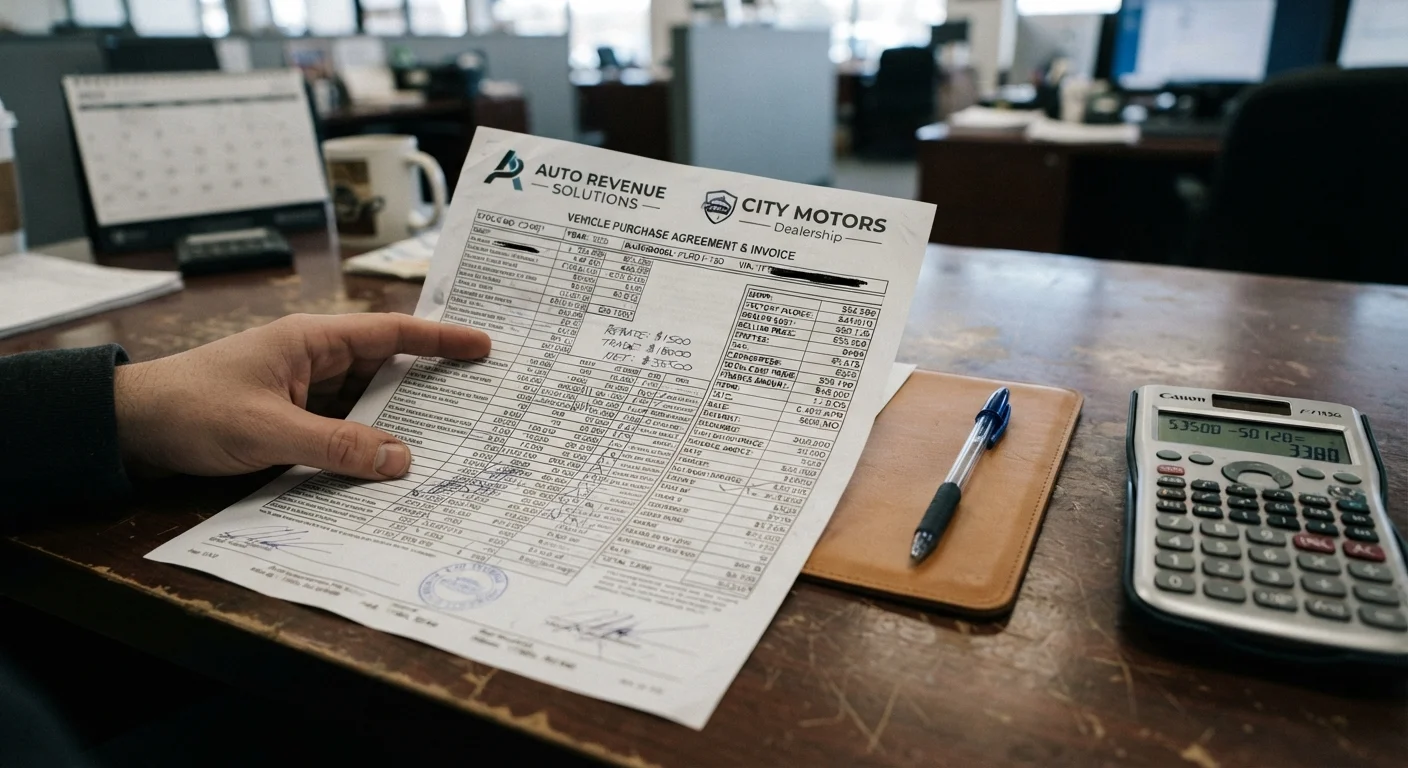
What Invoice Price Actually Represents
When shoppers discover invoice pricing, it often feels like finding a cheat code — a hard floor below which no dealer can go. That instinct is understandable but incomplete. Invoice price is the figure manufacturers charge dealers for a vehicle, and it appears on the dealer's paperwork. It looks like cost. It is not the same as cost.
To understand why, you need to know how money flows between manufacturers and dealers after the sale. Several payment streams run in the opposite direction — from manufacturer back to dealer — that effectively reduce what the dealer actually paid. For a fuller grounding in the two numbers most buyers encounter first, see Invoice Price vs. MSRP: Two Numbers Every Car Buyer Should Understand.
Myth
Invoice price is the dealer's actual cost, so buying at invoice means the dealer makes nothing.
Fact
Invoice is a billing figure, not a net cost. Holdbacks and incentives paid after the sale reduce what the dealer effectively spent.
The invoice represents the amount the dealer is billed by the manufacturer. However, holdback — typically 2–3% of MSRP — flows back to the dealer after each sale. On a $40,000 vehicle, that alone can represent $800–$1,200 returned to the dealer, entirely separate from any profit on the transaction itself.
Myth
If I negotiate to invoice, I've gotten the best possible deal.
Fact
Invoice is a useful benchmark, but dealer cash and volume bonuses may leave significant room below it on certain models.
Factory-to-dealer incentives — money manufacturers pay dealers rather than consumers — are often undisclosed and model-specific. In months when a manufacturer pushes a slow-selling trim, dealer cash can run several thousand dollars, creating real margin even on deals struck at or slightly below invoice.
Myth
All vehicles have the same gap between invoice and true cost.
Fact
The spread varies considerably by manufacturer, model popularity, and time of year.
High-demand vehicles that sell above MSRP may carry little or no dealer cash, meaning invoice is genuinely close to cost. Slow-selling models in a crowded segment may carry substantial manufacturer support. Researching specific models — not just applying a universal rule — produces more accurate expectations.
Myth
Holdback is just a small accounting technicality with no real impact on negotiations.
Fact
Holdback is a predictable, recurring payment that meaningfully affects a dealer's profit calculation on every unit sold.
Because holdback is paid quarterly by most manufacturers, dealers can factor it into their margin expectations on each vehicle. A salesperson accepting a deal that appears thin at invoice may be entirely comfortable because holdback makes the unit profitable at a higher level than the invoice math suggests. Understanding this dynamic reframes what "at cost" really means.
The Revenue Streams That Lower the Real Cost
Three mechanisms most commonly push a dealer's effective cost below invoice: holdback, dealer cash, and volume bonuses.
Holdback is a percentage of MSRP — commonly around 2–3% — that manufacturers pay back to dealers periodically after a vehicle is sold. It exists partly to offset floor plan financing costs (the interest dealers pay to keep vehicles on the lot). Because holdback is returned after the sale, it doesn't show up in the invoice number. For a detailed breakdown of how this payment works, Dealer Holdback: The Hidden Manufacturer Payment Most Buyers Never See covers the mechanics thoroughly.
Dealer cash (sometimes called factory-to-dealer incentives) is manufacturer money paid directly to the dealership, not passed to the consumer as a rebate. These incentives are often unadvertised and vary by model, region, and month. They can represent thousands of dollars on certain vehicles. See How Manufacturer Incentives and Rebates Flow Through the Pricing Chain for how these funds move through the system.
Volume bonuses reward dealers who hit monthly or quarterly unit-sales targets set by the manufacturer. A dealer close to a bonus threshold has a meaningful financial reason to accept a thinner margin on a single deal — the bonus payment on the full batch of vehicles can offset it.
2–3%
Typical holdback as a share of MSRP
Most domestic and international manufacturers structure holdback in this range, though rates vary by brand and are not publicly standardized.
$800–$2,000+
Estimated holdback on a mid-priced vehicle
On vehicles with an MSRP between $35,000 and $50,000, a 2–3% holdback translates to this dollar range returned to the dealer after the sale.
Together, these streams mean the gap between invoice and true dealer cost can be substantial on popular models during high-volume months. Dealer Holdback and Invoice Price: The Gap Behind the Sticker examines that spread in more detail.
What This Means at the Negotiating Table
Knowing invoice price is still useful — it anchors you to a published reference number and prevents you from paying well above market. The mistake is treating it as the absolute floor. A dealer selling at invoice isn't breaking even; on many transactions, they're still generating meaningful margin once holdback and any dealer cash are factored in.
Invoice Is a Reference Point, Not a Floor
Treating invoice as the dealer's break-even point is one of the most common negotiating errors buyers make. Holdback, dealer cash, and volume bonuses all exist below that line. This doesn't mean dealers are hiding profits maliciously — these are standard industry structures — but it does mean buyers who stop at invoice may leave money on the table on certain vehicles.
Practical approach: use invoice as a starting reference, then research whether the model carries significant dealer cash or holdback in your region that month. Manufacturer websites and several third-party pricing services publish consumer-facing rebate data, though dealer cash is harder to surface. Timing matters too — end-of-month pressure and quarter-end volume targets can open room that simply doesn't exist mid-month.
Also be aware that concessions on the vehicle price can be offset elsewhere. What Dealer Incentives Don't Tell You About the True Cost of a Deal explains how headline discounts sometimes mask adjustments in other parts of the deal, and Factors That Quietly Inflate the True Cost of a Car Loan covers how financing terms can erode savings secured on the purchase price. For a complete picture of where profit actually sits in a transaction, see How Dealers Actually Make Money on a Car Sale.
This article is for general informational purposes only and does not constitute financial or purchasing advice tailored to your specific situation. Pricing structures, incentive programs, and holdback rates vary by manufacturer, region, and model year. Consult multiple sources and consider speaking with a licensed automotive consultant before making significant purchasing decisions.