
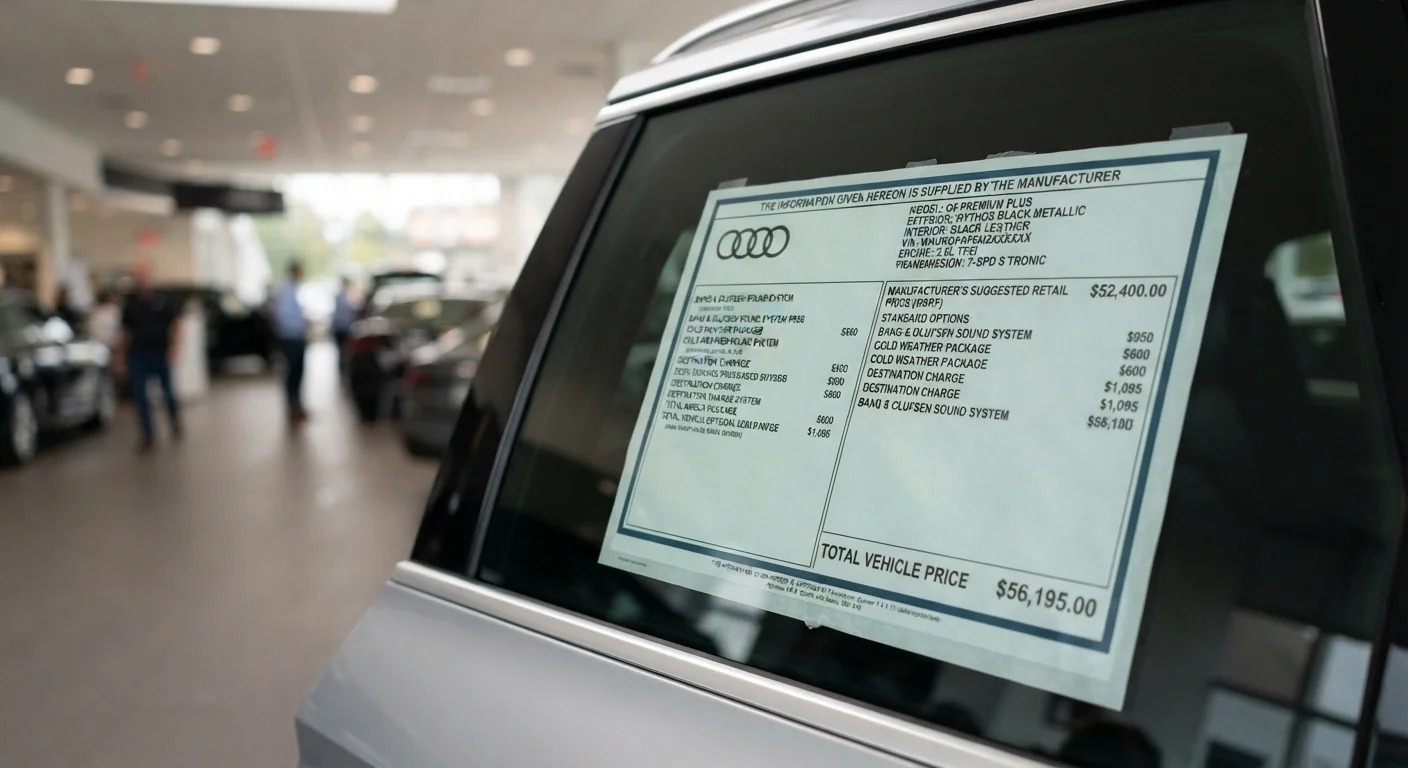
What MSRP Actually Is — and What It Isn't
MSRP — Manufacturer's Suggested Retail Price — is the price a vehicle maker recommends its authorized dealers charge consumers. It appears on the Monroney sticker (the federally required window label) and covers the base vehicle plus any factory-installed options and destination charges.
The critical word is suggested. Dealers are legally free to sell above or below MSRP, and market conditions often determine which direction they go. During periods of strong demand, dealers regularly add market adjustments that push the sale price above MSRP. During slow periods or at model-year end, sales frequently close below it. For a deeper look at how MSRP functions as a starting point rather than a final price, see our MSRP explainer.
MSRP is useful as a universal reference — every consumer can look it up on the manufacturer's website before stepping into a showroom. But treating it as the true ceiling or floor of any deal leads to a distorted picture of what a car actually costs to buy.
What Invoice Price Actually Is — and Why It's Not Dealer Cost
Invoice price is the amount printed on the manufacturer's invoice to the dealer — effectively the wholesale price a dealer pays for a vehicle before it lands on the lot. It is typically several hundred to a few thousand dollars below MSRP depending on the vehicle category and market segment.
Here is where many buyers get tripped up: invoice price is not the dealer's true cost. Several adjustments routinely reduce what the dealer actually paid net of all programs:
- Dealer holdback: A percentage of MSRP (commonly around 2–3%) that manufacturers pay back to dealers after a vehicle sells.
- Dealer cash or manufacturer-to-dealer incentives: Incentive programs, often unadvertised, that reduce effective cost further.
- Floor plan assistance: Reimbursements for interest costs dealers incur carrying inventory.
Because of these adjustments, a dealer can sell a vehicle at or even slightly below invoice and still profit. Our guide on dealer holdback and invoice price covers that gap in detail.
| Criterion | MSRP | Invoice Price |
|---|---|---|
| Set by | Vehicle manufacturer | Vehicle manufacturer |
| Represents | Recommended retail selling price | Dealer's wholesale purchase price |
| Visible to buyer? | Yes — on Monroney sticker | Researchable via pricing databases |
| Reflects dealer's true cost? | No | Not fully — holdbacks reduce net cost |
| Market can push sale price | Above (high demand) or below (slow market) | At or below in competitive conditions |
| Primary use for buyers | Benchmark for cross-shopping | Floor for negotiation targeting |
How These Two Numbers Work Together in Negotiation
The practical value of knowing both MSRP and invoice price is that together they define a realistic negotiating corridor. MSRP sets the ceiling most buyers recognize; invoice price anchors the floor where dealers still have margin room.
1–8%
Typical MSRP-to-invoice spread by segment
Industry pricing data generally shows the gap between MSRP and invoice ranging from roughly 1% on entry-level economy vehicles to 8% or more on larger trucks and SUVs.
2–3%
Common dealer holdback as % of MSRP
Many manufacturers pay dealers a holdback of approximately 2–3% of MSRP after a vehicle sells, meaning invoice-price deals can still be profitable for the dealer.
Real-world transaction prices — what buyers actually pay — tend to cluster somewhere between invoice and MSRP under normal market conditions, though that spread shifts with supply and demand. Industry data tracked by sources such as Edmunds and Cox Automotive regularly show average transaction prices moving above or below MSRP depending on the model and the moment. For broader context on how actual sale prices compare to sticker figures, see transaction price vs. sticker price.
A grounded negotiation approach starts by researching both figures before you enter the dealership. Pricing databases such as Edmunds, TrueCar, and the NADA Guides publish invoice data that is generally reliable, though minor regional variation exists. A plain-language breakdown of all three key pricing terms can help you keep them straight during an actual negotiation.
Neither MSRP nor invoice price is a secret weapon on its own. Used together, they frame a fact-based conversation — one where you can make a reasonable offer and evaluate a dealer's counteroffer without guessing.
Invoice Price Data Isn't Always Exact
Consumer-facing invoice price figures published by third-party sites are estimates based on manufacturer data, and minor discrepancies can exist due to regional adjustments or late-breaking incentives. Treat published invoice figures as a reliable approximation rather than a guaranteed precise number. Using multiple sources — Edmunds, NADA Guides, and the manufacturer's own configurator — cross-checks your baseline before you negotiate.
This article is for general informational and educational purposes only. Pricing figures vary by vehicle, region, and market conditions. Consult published pricing guides and, where relevant, a licensed financial professional before making significant purchase or financing decisions.