
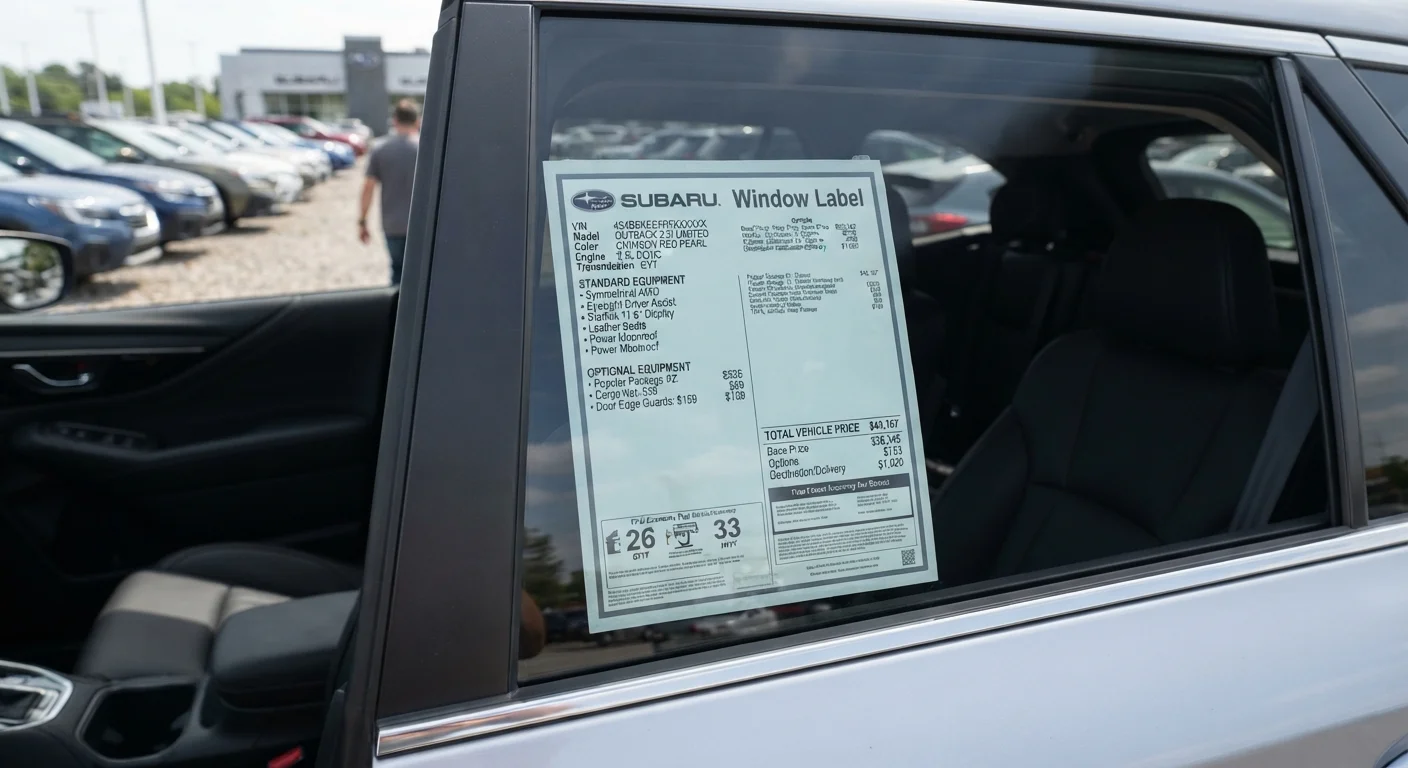
What the Window Sticker Actually Contains
Every new car sold in the United States is required by law to display a Monroney sticker — the official window label that itemizes the vehicle's pricing. Understanding what's on that sticker is the first step to evaluating any deal.
A standard Monroney sticker breaks down into four main components:
- Base price: The cost of the vehicle in its standard configuration, with no optional equipment.
- Factory-installed options: Each add-on package or feature selected at the factory, listed individually with its price.
- Destination and delivery charge: A fixed fee the manufacturer charges to ship the vehicle from the plant to the dealership. This charge is non-negotiable and the same for all buyers at a given distance tier.
- Total MSRP: The sum of the above three line items.
What the sticker does not include: sales tax, state registration fees, documentation fees, dealer-installed accessories, or any financing costs. For the full picture, see what out-the-door pricing actually covers.
Destination Charge Is Always Part of MSRP
The destination and delivery charge is included in the total MSRP figure and is set by the manufacturer — not the dealer. It covers the cost of transporting the vehicle from the assembly plant to the dealership. Unlike most other line items, this fee is fixed and cannot be negotiated away, so factor it in when comparing prices across dealers.
Why MSRP Diverges from the Actual Transaction Price
The gap between what the sticker says and what a car actually sells for is driven by supply, demand, and dealer discretion — not the manufacturer.
When a model is in short supply or generating strong consumer interest, dealers may add a market adjustment above MSRP, sometimes labeled ADM on a supplemental sticker. Conversely, when inventory is plentiful or a model is slow-moving, dealers routinely discount below MSRP to move units — especially toward the end of a model year.
This is why industry transaction price data matters. Average transaction prices, tracked by automotive research firms, can differ materially from MSRP and reflect what buyers are actually paying in real market conditions. Transaction price vs. sticker price explores this gap in detail.
~$50,000
Average new vehicle transaction price (recent U.S. market)
Cox Automotive and Kelley Blue Book data have tracked average new vehicle transaction prices near or above $48,000–$50,000 in recent years, often at or above MSRP for many segments.
1–8%
Typical MSRP-to-invoice spread by vehicle segment
The gross margin between invoice and MSRP generally ranges from roughly 1% on entry-level economy vehicles to 8% or more on trucks and luxury models, according to industry pricing analysts.
MSRP vs. Invoice: Two Different Numbers, Two Different Purposes
Buyers often conflate MSRP with dealer cost, but they serve entirely different functions. MSRP faces consumers; invoice price faces the manufacturer-to-dealer relationship.
Invoice price is nominally what the dealer pays for the vehicle. The spread between invoice and MSRP provides a rough negotiating reference, but it's an incomplete picture — dealers also receive holdbacks (a percentage of MSRP rebated by the manufacturer after the sale) and manufacturer-to-dealer incentives that can meaningfully lower their effective cost below invoice.
For a complete side-by-side breakdown, invoice price vs. MSRP explained covers both figures and what they signal for negotiation. You can also find all three core pricing terms — invoice, MSRP, and dealer cost — contextualized together in this plain-language pricing breakdown.
Check Transaction Prices Before You Visit
Before stepping into a dealership, look up the average transaction price for the specific trim you want using a reputable automotive research resource. If the market average is running below MSRP, you have a data-backed justification to negotiate down. If vehicles are selling above sticker, you'll know that upfront rather than being surprised at the desk.
Using MSRP as a Negotiating Anchor
MSRP's real value in a negotiation isn't as a target — it's as a reference point. Knowing the sticker price, the invoice price, and current average transaction prices gives you a three-point framework to evaluate whether any given offer is reasonable.
A few practical principles:
- Don't anchor on MSRP as the ceiling. In a buyer's market, paying full MSRP on a slow-selling model is leaving money on the table.
- Watch for markup stacking. Dealers sometimes add dealer-installed accessories (window tinting, paint sealant, cargo mats) to a supplemental sticker, inflating the effective asking price above MSRP without adjusting the Monroney label itself.
- Focus on out-the-door price. All negotiation should ultimately be evaluated against the total you'll write a check for, not the sticker subtotal.
Purchase price, of course, is only the beginning. The true cost of owning a car beyond the sticker price addresses the ongoing expenses that follow you home from the dealership.