
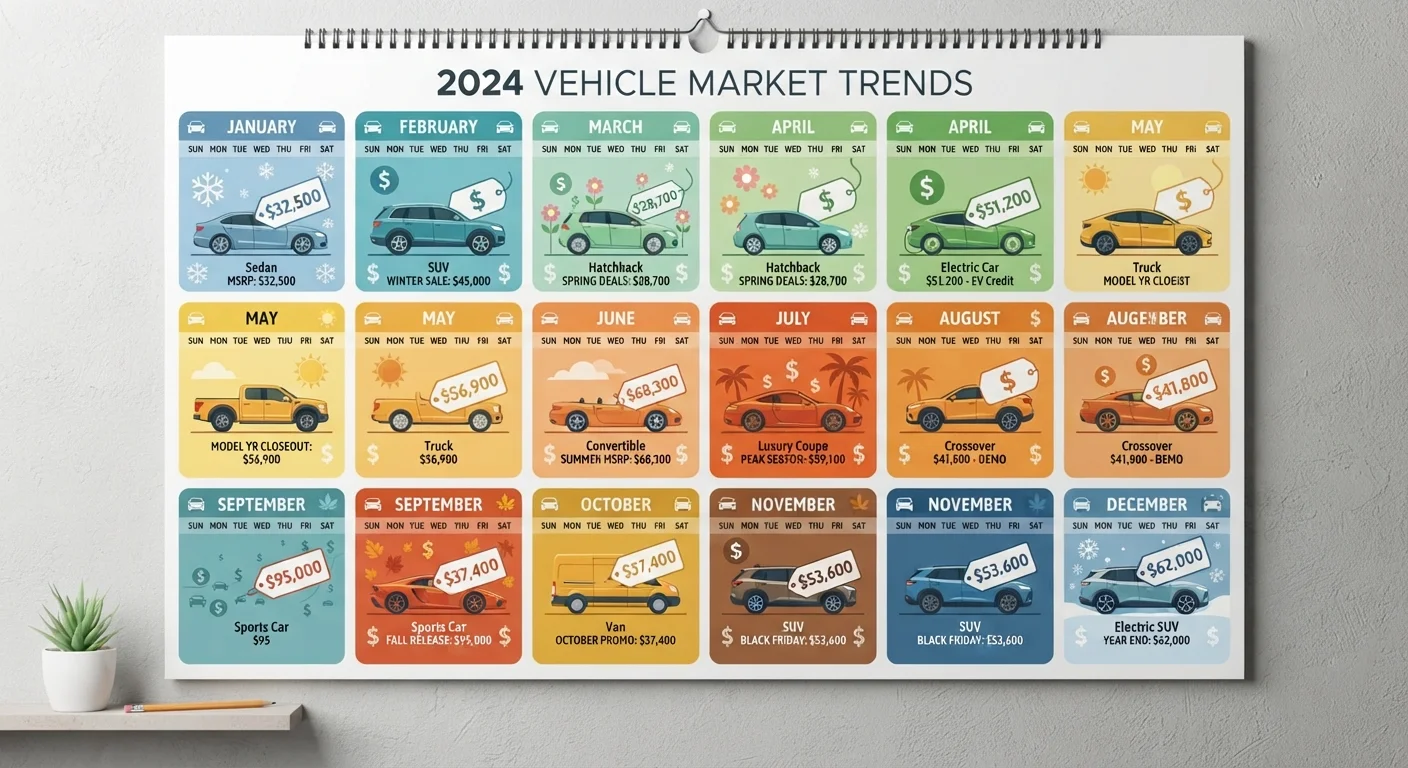
Why Car Prices Move With the Calendar
Dealerships operate on quotas, manufacturers run time-limited incentive programs, and consumer demand surges and dips with the seasons. These forces combine to create recurring pricing patterns that informed buyers can use to their advantage. Understanding those patterns is foundational to car pricing basics.
Two primary drivers shape seasonal pricing. First, model-year changeovers: when new model-year vehicles arrive (typically late summer through fall), dealers discount the outgoing year's inventory to clear floor space. Second, sales quotas: manufacturers and dealers operate on monthly, quarterly, and annual cycles, creating pressure to move units at certain calendar points. Neither force works in isolation — they overlap, and savvy buyers position themselves at those intersections.
| Strongest buyer window (new cars) | August–October (model-year changeover) (Industry consensus based on recurring OEM incentive cycles) |
| Weakest buyer window | March–May (tax refund demand spike) |
| End-of-year pressure peak | Last week of December (Annual dealer quota cycles) |
| Model-year arrival window | Typically August–October (Varies by manufacturer and segment) |
| Monthly quota reset | Final 3 business days of each month (Dealer sales cycle standard) |
| Tax refund demand peak | Late February–April (IRS refund disbursement timing) |
Month-by-Month Pricing Breakdown
January–February: Post-holiday demand drops sharply. Dealers who missed year-end quotas carry that pressure into the new year, and manufacturers often extend incentive programs to stimulate sluggish traffic. Historically one of the buyer-friendliest windows for new vehicles, though selection on prior-model-year units is limited by this point.
March–May: Tax refund season brings increased foot traffic and rising demand. Prices firm up, and dealer negotiating flexibility narrows. This period generally favors sellers. If you must buy in spring, aim for early March before refund checks clear widely.
June–July: A transitional window. Some dealers begin receiving next model-year vehicles, which creates light pressure to move current inventory. Manufacturer mid-year sales events can surface genuine rebates — but read the fine print, since advertised deals sometimes require specific financing through the manufacturer's captive lender. See how rate environments interact with those offers at Rates & Payments.
August–October: Historically the strongest buyer's window of the year. New model-year vehicles arrive in volume, outgoing models accumulate on lots, and dealers face real clearance pressure. Discounts on prior-model-year units can be substantial. New and used prices move differently during this period — used values can soften too as trade-in volume increases.
November–December: End-of-year pressure on dealers to hit annual targets creates genuine negotiating leverage, particularly in December's final week. Manufacturer year-end sales events are common. This is also when being focused on total purchase price — not monthly payment — matters most. Urgency tactics peak in December; keep perspective by reviewing why monthly payment focus gets buyers into trouble.
Model-year changeover
The period when a manufacturer transitions production and dealer inventory from the current model year to the next. Outgoing vehicles often receive steeper discounts during this window to clear lot space.
Manufacturer incentive
A time-limited discount program offered directly by the automaker, typically as cash rebates or below-market financing rates. Incentives vary by model and region and are not always advertised at their full value.
Sales quota
Monthly or annual unit-sales targets set by manufacturers for dealers, and by dealership management for individual salespeople. Approaching a quota deadline increases dealer motivation to close deals.
Captive lender
A financing arm owned by the automaker (e.g., a manufacturer's own financial services division). Promotional rates are often available only through the captive lender and may require forgoing a cash rebate.
Holdback
A percentage of MSRP (typically 2–3%) that the manufacturer reimburses to the dealer after a vehicle sells. Holdback provides dealers a profit cushion even on deals that appear to be at or below invoice.
Applying the Calendar to Your Strategy
Timing alone doesn't close a good deal — it opens the door. Once you identify a favorable window, layer in these considerations:
- End-of-month visits: Salespeople and managers face monthly quota resets. The final three business days of any month add pressure independent of season. Calendar timing affects your negotiating position in ways that go beyond just picking the right month.
- Rebates vs. low-rate financing: Manufacturer incentives often force a choice between a cash rebate and a below-market financing rate. Run both scenarios with your actual loan amount before deciding.
- Used car seasonality: Used pricing follows slightly different cycles driven by auction volumes and rental fleet liquidations. Used car market pricing and supply dynamics determine when used values soften most.
- Interest rate environment: A favorable calendar window can be partially offset by a high-rate lending environment. Rate cycles affect auto financing decisions and should factor into your overall timing calculus.
Incentives and Financing Rates Often Trade Off
Many manufacturer promotions require buyers to choose between a cash rebate and a special low-APR financing offer — not both. The better deal depends on your loan amount, term, and the prevailing market rate. Always calculate the total interest cost of the special rate versus taking the rebate and financing separately before committing to either path.
This article provides general educational information about historical pricing patterns. Actual prices, incentives, and market conditions vary by region, vehicle segment, and economic environment. This is not personalized financial advice — consult a qualified financial professional for guidance specific to your situation.