
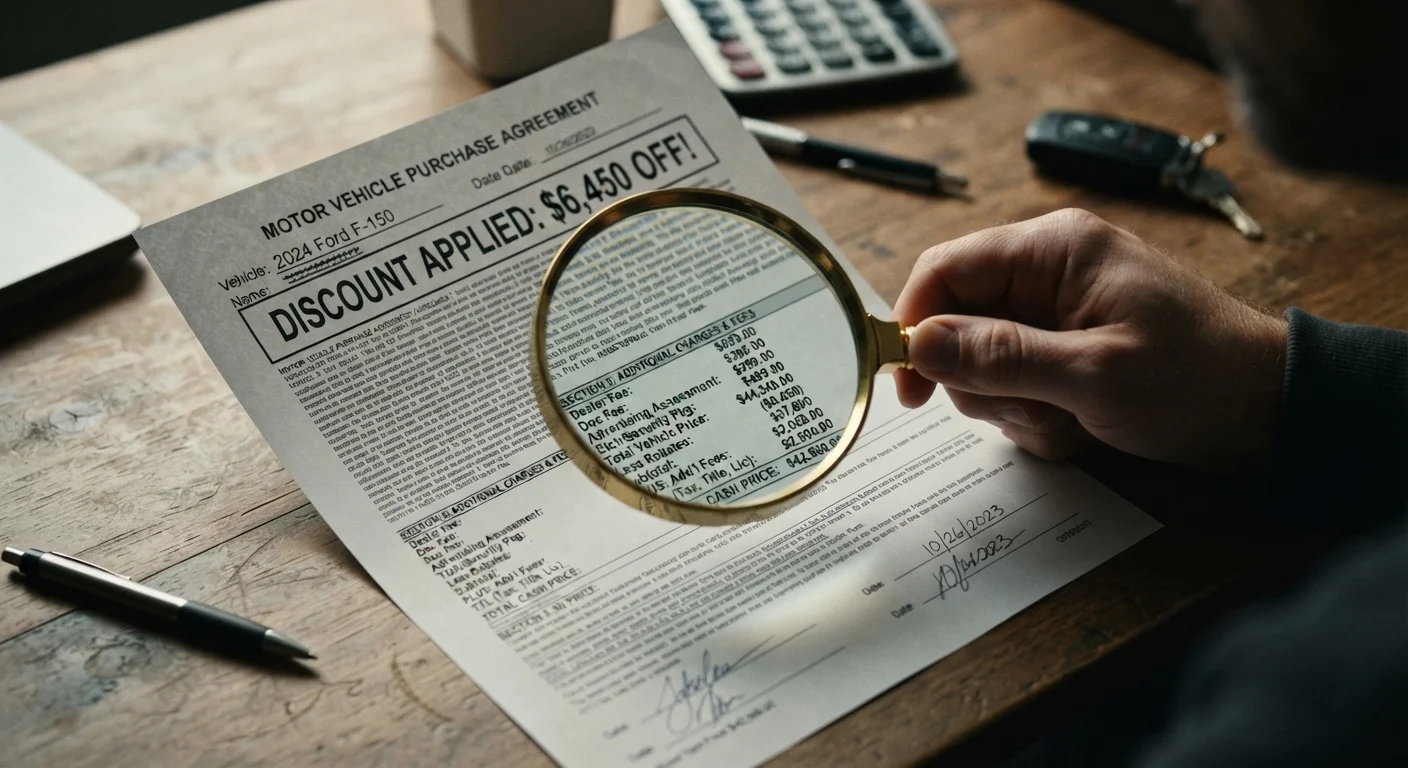
Why the Incentive Headline Is Rarely the Whole Story
A prominent discount or cash-back offer catches attention for a reason — it's designed to. But the figure an automaker or dealer advertises as savings exists within a deal structure that has multiple adjustable levers: selling price, trade-in valuation, finance rate, lease residual, and back-end products. Moving one lever favorably often means another shifts in the dealer's favor.
Understanding this dynamic doesn't require suspicion of every offer — it requires a framework for evaluating total cost rather than isolated line items. The basics of how car pricing works are the foundation, and incentives only make sense layered on top of that understanding.
Incentives Are Marketing Tools First
Every incentive a dealership promotes is designed to move inventory, not to maximize your savings. The advertised figure rarely represents the full picture of what you'll actually pay. Always calculate the total drive-off and total financed amount before agreeing to any deal structure.
Before examining any specific mistakes buyers make, it's worth noting that dealers themselves operate within manufacturer programs that constrain what they can offer and when. The gap between invoice price and true dealer cost also affects how much real room exists behind any promoted deal.
The Most Costly Mistakes When Evaluating Incentive Offers
Each of the errors below occurs not from carelessness but from how deal information is presented. Knowing the pattern is the first step to working around it.
Treating the incentive amount as a direct reduction to what you pay out of pocket.
Why it happens: Promotional materials present incentives as dollar savings, which feels equivalent to a price cut — but the baseline price, fees, and financing rate may all be adjusted to absorb part of that figure.
Confusing manufacturer cash rebates with dealer discounts, treating them as equivalent.
Why it happens: Both appear as savings on a deal sheet, but manufacturer rebates come from the automaker's marketing budget while dealer discounts come from gross profit margin — the source determines how they can be applied and stacked.
Assuming all promoted incentives can be combined with every other available offer.
Why it happens: Dealership advertising highlights individual rebates without always clarifying that choosing one may disqualify another — for example, a low-APR financing offer and a cash rebate are often mutually exclusive.
Ignoring documentation fees, dealer prep charges, and add-ons that offset the incentive value.
Why it happens: Buyers focus on the vehicle price and incentive headline and mentally set aside the back-end charges until signing — by which point the excitement of the deal makes objecting feel awkward.
Treating a time-limited incentive as evidence that the deal itself is genuinely favorable.
Why it happens: Month-end or quarter-end promotions create a sense of scarcity that compresses evaluation time, pushing buyers to commit before comparing alternatives.
Buyers who understand these patterns are also better positioned to recognize moments where savings are quietly surrendered after a headline deal is agreed. Extras and financing packages are common recovery mechanisms dealers use once the vehicle price is locked in.
Reading a Deal Sheet With the Right Lens
A complete deal evaluation starts with separating five distinct numbers: the negotiated selling price, the manufacturer rebate applied, the documentation and dealer fees, the trade-in allowance (if applicable), and the effective APR on any financed amount. Each of these is negotiable or researchable independently.
~$1,000–$2,000
Typical documentation fee range across U.S. states
State-level caps vary widely; some states have no cap at all, meaning doc fees alone can partially or fully offset a promoted rebate.
3–5%
Dealer markup range on financing (dealer reserve)
Dealers are typically permitted to mark up the buy rate from lenders by up to a few percentage points, which can add thousands in interest over the loan term.
The finance desk is where the most significant post-negotiation adjustments happen. Dealer reserve — the markup a dealer adds to the lender's buy rate — can materially change the total cost of a financed deal. Add-on products and loan fee structures compound this effect. Arriving with a pre-approved rate from a bank or credit union gives you a benchmark the dealer must compete with, not replace.
Watch for Inflated Residuals on Leases
When a manufacturer subsidizes a lease deal, it may inflate the residual value to lower the monthly payment artificially. This makes the monthly cost look attractive but can leave you with a buyout price that doesn't reflect actual market value at lease end. If you're considering purchasing at the end of a lease, research current market values independently before signing.
For a broader view of the habits and structural factors that lead buyers to overpay, the cognitive patterns behind overpayment are worth understanding before any negotiation. Incentives are one component of a larger system — and the buyers who do best are those who treat the full system as the subject of negotiation, not just the sticker price.
This article is for general informational purposes only and does not constitute financial, legal, or purchasing advice. Pricing, fees, and incentive structures vary by dealer, region, and market conditions. Consult appropriate professionals for decisions specific to your situation.