
Why the Source Matters as Much as the Car
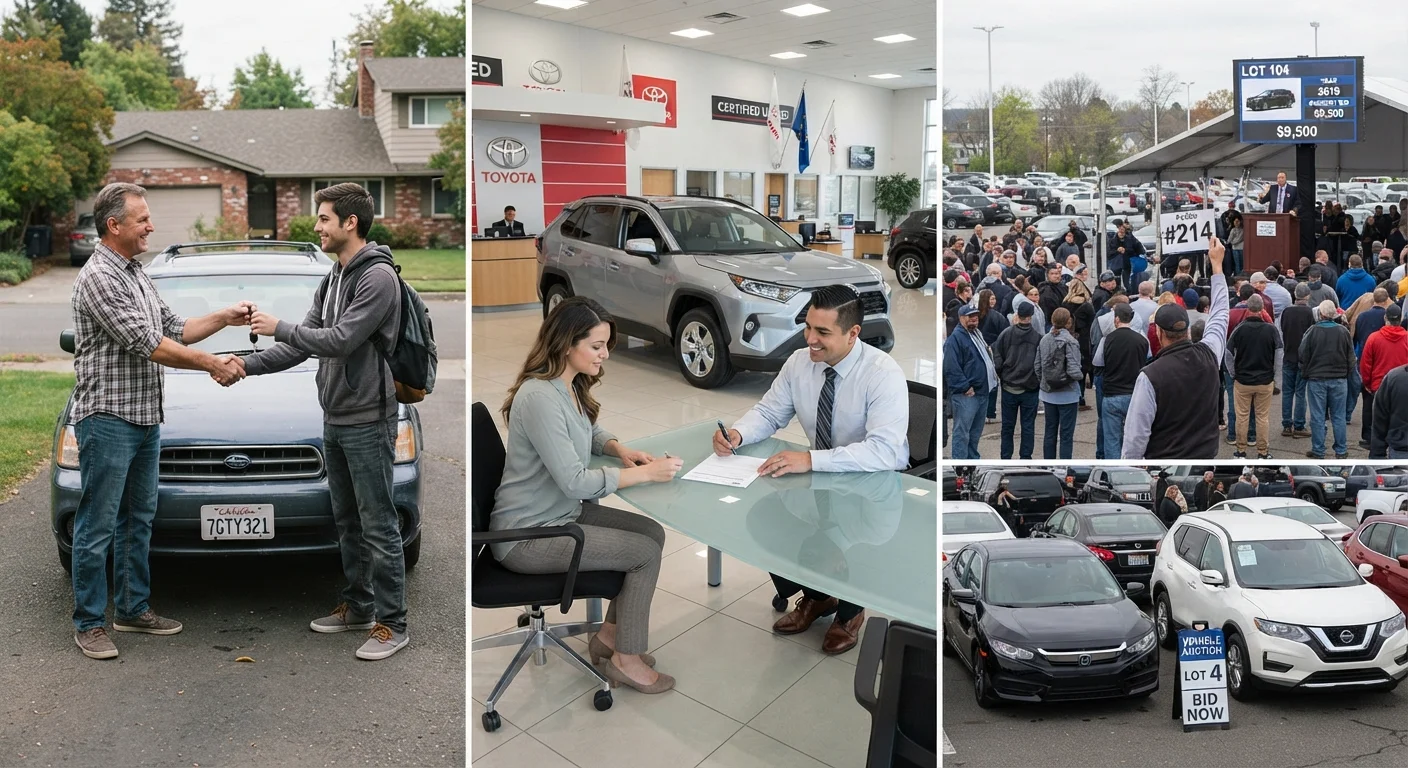
When shopping for a used vehicle, buyers often focus almost entirely on the car itself — mileage, condition, service history — while underweighting how much the purchase channel shapes their risk exposure, legal protections, and total cost. The same car sold by a private owner, a franchised dealer, and an auction house represents three genuinely different transactions. Understanding those differences before you shop is how you avoid paying for protections you don't need — or missing ones you do.
For a broader framing of why used cars carry different trade-offs than new ones, see our honest breakdown of used car advantages and risks.
| Private Seller | Independent Dealer | Franchised Dealer (CPO) | Auction | |
|---|---|---|---|---|
| Typical price point | Lowest | Mid-range | Highest | Variable, can be low |
| Buyer protections | Minimal — as-is in most states | State lemon/disclosure laws | Strongest — CPO warranty included | Very limited — sold as-is |
| Vehicle history access | Buyer must request/pull | Usually provided | Standard; inspected | Often minimal or none |
| Financing options | None — buyer arranges | Some — third-party lenders | Full in-house financing | Pre-arranged or cash only |
| Negotiation room | High | Moderate | Limited | Bid-based, no negotiation |
| Pre-purchase inspection | Usually allowed | Permitted at reputable lots | Inspection already performed | Rarely permitted |
| Test drive | Typically yes | Yes | Yes | Usually not |
| Paperwork complexity | High — buyer handles transfer | Moderate | Dealer handles most | Buyer handles post-auction |
Private Sellers: Lower Price, Higher Due Diligence
Buying directly from an individual typically offers the lowest purchase price because there's no dealer overhead — no lot fees, no reconditioning markup, no financing department profit. That price advantage is real. But it comes paired with the thinnest legal safety net of any channel.
Most states treat private-party vehicle sales as as-is transactions. Once money changes hands, the seller's legal obligations are largely discharged. Misrepresentation or fraud is theoretically actionable, but pursuing it is costly and rarely worth the effort on a $10,000 car. This means the buyer's due diligence has to substitute for the protections that a dealer environment would otherwise provide.
"As-Is" Sales Limit Your Legal Recourse
Private sales in most U.S. states are legally treated as as-is transactions, meaning the seller has no obligation to repair undisclosed defects after the sale closes. Even if a problem surfaces immediately after purchase, recovering costs is difficult without proving deliberate fraud. If you're buying from a private party, a pre-purchase inspection by an independent mechanic is not optional — it's essential.
Best practices when buying privately: pull a vehicle history report using the VIN, arrange an independent pre-purchase inspection at a mechanic of your choosing (budget $100–$200), verify the title is clean and the seller's name matches the title, and never pay before completing those steps. Financing must also be arranged independently — personal loans, credit union auto loans, or cash.
Private sellers work best for buyers who are mechanically confident or have reliable mechanic access, and who are comfortable handling DMV paperwork and title transfer on their own.
Dealerships: More Protections, More Overhead
Franchised dealerships (those affiliated with a manufacturer) and independent used-car lots both operate under state dealer licensing requirements and consumer protection laws that don't apply to private sellers. Dealers are generally required to disclose known defects, provide a Buyers Guide on used vehicles outlining warranty terms or as-is status, and follow federal odometer disclosure rules.
Franchised dealers also offer Certified Pre-Owned (CPO) programs — manufacturer-backed inspections and limited warranties layered on top of the standard purchase. CPO vehicles carry a price premium, but that cost buys measurable peace of mind: multi-point inspections, powertrain warranty extensions, and often roadside assistance. Whether the premium is worth it depends on the vehicle's age, mileage, and your risk tolerance.
Always Pull a Vehicle History Report
Regardless of which channel you use, run a vehicle history report using the VIN before committing to any purchase. These reports flag title issues, odometer rollbacks, accident records, and prior salvage designations — information that doesn't show up in a seller's description. Budget roughly $25–$40 for a report; it's one of the lowest-cost safeguards available to any used car buyer.
Independent used-car lots sit between private sellers and franchised dealers in terms of protections. State disclosure laws still apply, but there's no manufacturer-backed CPO program and quality control varies significantly by lot. Vet any independent dealer through your state's DMV dealer licensing database and look for a clean Better Business Bureau record before proceeding.
Dealers also simplify financing — they can process loans through multiple lenders in a single visit. That convenience has a cost: dealer-arranged financing sometimes carries a rate markup. Arriving with a pre-approval from your own bank or credit union gives you a benchmark to compare against. For more on the financing side of the used car decision, working through the key questions before choosing new or used covers financing factors directly.
Auctions: Potential Value, Serious Risk
Vehicle auctions — including public auctions, government fleet sales, and online auction platforms — can surface competitively priced inventory, particularly off-lease vehicles, fleet units, and repossessions. The appeal is real: auction prices sometimes run below retail private-party values.
The tradeoffs are significant. Most auction vehicles are sold with no test drive, no independent inspection, and minimal (or inaccurate) condition disclosures. You're often bidding on a vehicle you've had minutes to visually assess. Online auction formats reduce even that opportunity. Mechanical surprises post-purchase are common, and recourse is limited once the hammer falls.
Auctions are most viable for buyers with direct mechanical expertise, the ability to arrange rapid professional inspection (some auction facilities allow brief pre-auction inspections during designated preview windows), or those buying at high enough volume to absorb the occasional bad purchase. For the typical individual buyer acquiring one vehicle for personal use, the risk-to-reward ratio at auction is rarely favorable compared to a well-vetted private seller or dealer purchase.
Wherever you end up buying, understanding the full used-car process — from research through ownership transfer — is worth the time. Our end-to-end guide to navigating a used car purchase covers every stage in detail.
~40%
Used cars sold via private party annually
Industry estimates suggest roughly 40% of used vehicle transactions in the U.S. occur between private parties rather than through dealerships.
$1,000–$3,000+
Typical CPO premium over non-CPO comparable
Consumer automotive research generally finds CPO vehicles carry a measurable premium over comparable non-certified used inventory, reflecting inspection and warranty costs.
This article provides general educational information about used vehicle purchasing channels. It is not legal, financial, or professional advice. Vehicle laws and consumer protections vary by state; consult your state's DMV and, for financial decisions, a qualified adviser.