
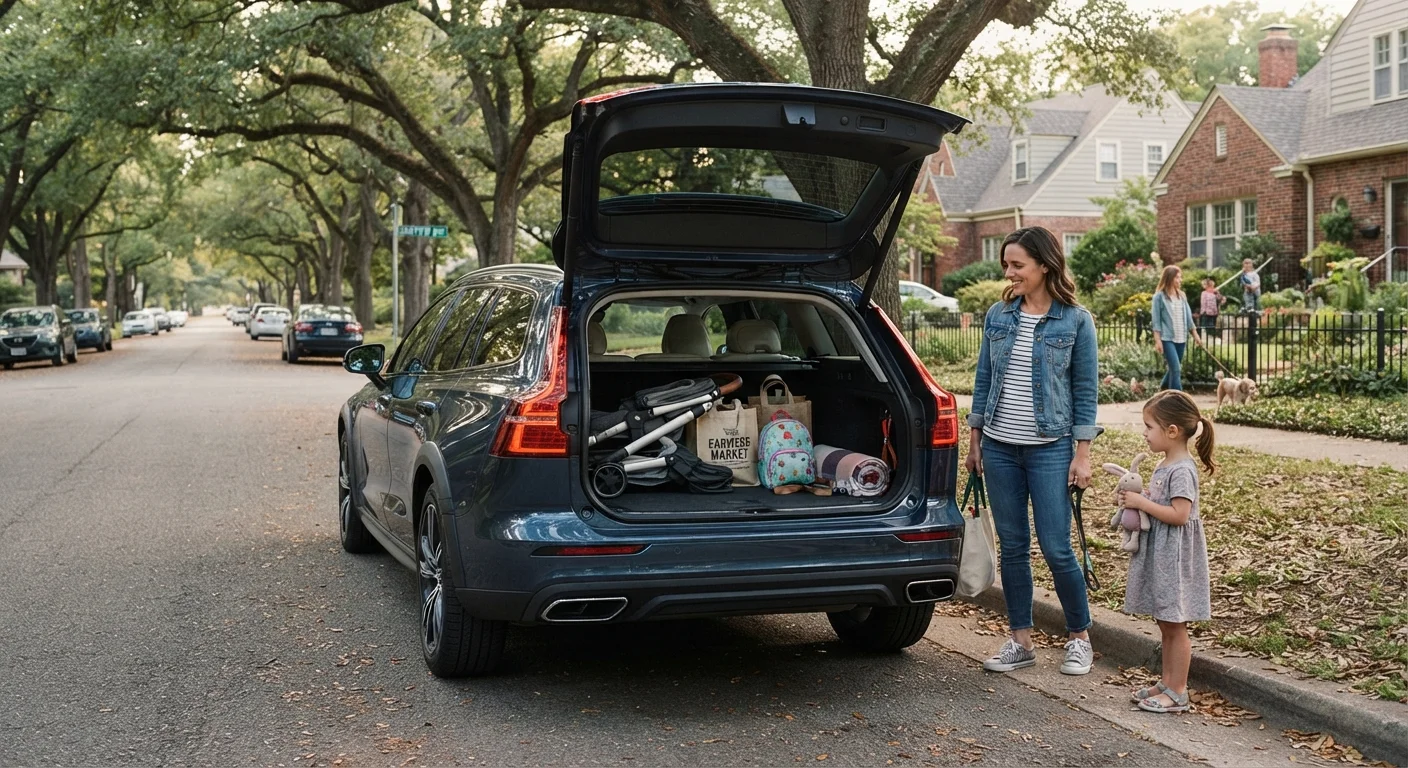
What Makes a Station Wagon a Wagon
At its core, a station wagon is defined by one architectural decision: extending the passenger cabin rearward and capping it with a liftgate rather than a separate trunk lid. The roofline doesn't drop behind the rear seats — it continues, creating a unified interior volume that combines passenger space and cargo area seamlessly.
That single design choice produces real, measurable benefits. A flat load floor makes it easy to slide in flat-pack furniture, camping gear, or sports equipment. Rear seats that fold flat expand capacity dramatically. And because the cargo area is enclosed within the cabin, it stays protected from the elements and out of sight from would-be thieves — something open truck beds and external roof racks can't offer.
For a broader look at how wagons sit within the full spectrum of body styles, see our guide to major vehicle body styles.
Why Wagons Faded — and Why They Didn't Vanish
The American wagon's decline is well-documented. Through the 1980s, they were the default family hauler. By the mid-1990s, the minivan had taken child-transport duties and the SUV was seizing the imagination of buyers who wanted height, presence, and perceived ruggedness. Wagons, positioned as neither sporty nor commanding, lost the cultural moment.
Yet they never left entirely, for a practical reason: their engineering formula is genuinely efficient. Same platform as a sedan, meaningfully more space, no major weight or aerodynamic penalty. Automakers — especially European ones — recognized there was still a buyer for whom driving feel mattered more than ride height. That buyer kept the wagon alive, even as it became a niche rather than a mainstream choice.
~30–70%
More cargo volume vs. comparable sedan
General range based on published cargo specifications across typical wagon and sedan models in similar vehicle segments.
1990s
Decade wagons lost US mainstream dominance
The rise of minivans and SUVs through the 1990s sharply reduced wagon market share in the United States.
5
Typical seating capacity in modern wagons
Unlike three-row SUVs, virtually all current wagon models are designed for five occupants, limiting group transport capacity.
Today's US wagon market is largely defined by performance and near-luxury offerings rather than budget family vehicles. That shift repositioned wagons as driver-focused alternatives rather than compromise choices.
The Real Trade-Offs Buyers Should Weigh
Wagons aren't the right fit for everyone, and understanding the trade-offs helps set realistic expectations.
- Ground clearance: Most wagons sit low, which limits their capability on rough terrain, deep snow, or unpaved roads compared to a crossover or SUV with all-wheel drive and raised suspension.
- Seating capacity: Nearly all wagons seat five. If you regularly need to carry six or seven passengers, a three-row SUV or minivan is a better structural solution.
- Availability: The US market offers far fewer wagon options than sedan or SUV segments. Finding your preferred configuration may require a broader search or a factory order.
- Perception: For some buyers, vehicle image matters. Wagons carry none of the visual authority of an SUV, which can be a dealbreaker or an irrelevant non-issue depending on the person.
Test the Cargo Floor Before You Decide
When evaluating any wagon, bring a piece of gear that represents your most common large load — a stroller, a bike wheel, a large cooler — and test the actual loading process. The width of the hatch opening, the height of the load floor lip, and the depth of the cargo area vary meaningfully between models and matter more in daily use than raw volume numbers on a spec sheet.
On the plus side, wagons typically park more easily than SUVs, handle more like sedans, and often return better fuel economy than crossovers in their class — advantages that compound over daily use.
To think through whether a wagon fits your specific routine, matching body styles to lifestyles is a useful next step.
How Wagons Compare to Sedans and Hatchbacks
Buyers often struggle to place wagons relative to their closest relatives: the sedan and the hatchback. All three are car-based body styles, but they serve slightly different priorities.
A sedan prioritizes a clean silhouette and trunk separation — useful for keeping cargo hidden but limited in volume and awkward for tall items. A hatchback adds a rear hatch to a shorter body, giving you flexibility in a compact footprint. A wagon extends that logic: more length, more height in the cargo zone, and a larger absolute volume without requiring you to step up to a truck-based vehicle.
Comparing sedans, hatchbacks, and wagons side by side can help clarify which shape fits your specific cargo and passenger patterns.
Deciding Whether a Wagon Belongs in Your Garage
The wagon still fills a real, if narrow, slot in the vehicle landscape. It suits a driver who values cargo capacity and practicality but doesn't want to give up car-like handling, a lower step-in height, or the fuel efficiency that comes with a lighter, more aerodynamic profile.
If your driving involves regular highway miles, urban parking, and occasional large cargo loads — without consistent off-road or severe winter conditions — a wagon deserves serious consideration alongside crossovers in your evaluation.
Not sure where to start that evaluation? Working through key questions before settling on a body style can help you pressure-test your assumptions before committing. And for a comprehensive overview of every major body style, everything you need to know about vehicle body styles covers the full picture in one place.