
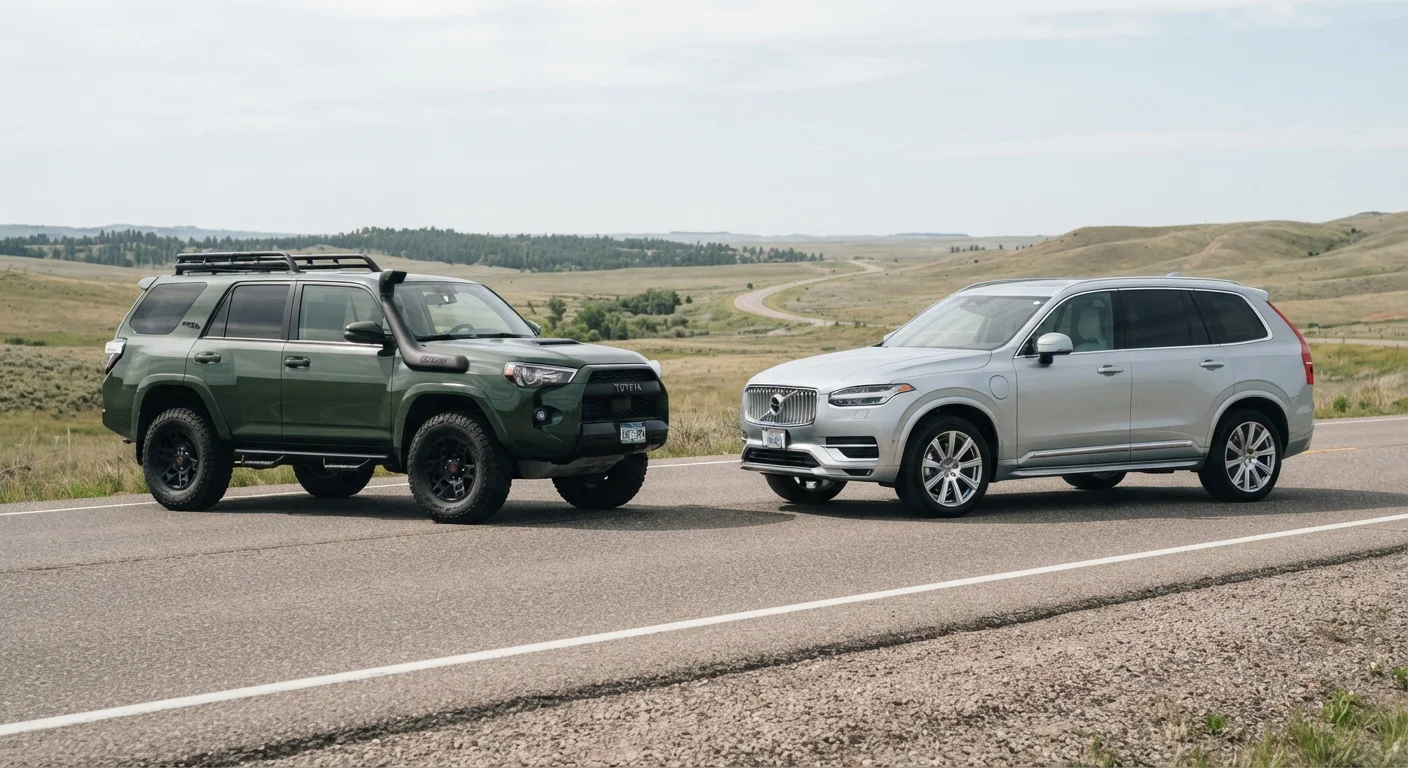
The Core Difference: How Each Vehicle Is Built
The SUV vs. crossover debate starts underneath the skin. A traditional SUV — think full-size and some midsize body-on-frame models — is built on a ladder frame: a rigid steel chassis onto which a separate body is mounted. This is the same basic architecture used by pickup trucks, which is exactly where the design originated.
A crossover utility vehicle (CUV), on the other hand, uses a unibody construction — a single integrated structure where the body and frame are one piece. This is the same approach used in most sedans and hatchbacks. The crossover borrows the raised ride height and utility-focused packaging of an SUV but plants it on a car-derived platform.
This single engineering decision ripples through every aspect of real-world ownership: ride quality, fuel efficiency, towing limits, and off-road capability all trace back to it. For a broader look at how construction shapes different vehicle categories, see our body styles overview.
| Criterion | Traditional SUV | Crossover (CUV) |
|---|---|---|
| Construction | Body-on-frame (ladder frame) | Unibody (integrated body/frame) |
| Platform origin | Truck-derived | Car-derived |
| Towing capacity | Generally higher (often 7,000–12,000+ lbs) | Typically lower (1,500–5,000 lbs) |
| Off-road capability | High; often includes low-range 4WD | Moderate; suited to light trails and all-weather roads |
| Fuel economy | Lower (heavier platform) | Higher (lighter unibody construction) |
| Ride quality | Firmer, truck-like feel | Smoother, more car-like feel |
| Cargo access | Higher load floor, step-up entry | Lower load floor, easier access |
| Weight | Heavier overall | Lighter overall |
Capability, Ride, and Real-World Trade-Offs
Body-on-frame SUVs carry meaningful advantages for demanding tasks. Their frames are engineered to handle the stress of heavy towing, and many are offered with low-range four-wheel drive — a dedicated gear reduction system that delivers maximum torque at slow speeds on rough terrain. If your weekends involve pulling a fifth-wheel camper or navigating serious off-road trails, this architecture is purpose-built for that work.
Crossovers trade peak capability for daily livability. Unibody construction reduces overall vehicle weight, which contributes to better fuel economy and a noticeably smoother, quieter cabin. The lower load floor makes it easier to load groceries or lift children into car seats. Handling tends to feel more car-like, with less body roll through corners than a traditional truck-based SUV.
~75%
Share of US SUV/CUV sales that are crossovers
Industry analysts broadly estimate that crossovers account for the large majority of vehicles sold under the SUV umbrella in the US market.
15–25%
Typical fuel economy difference between body types
Unibody crossovers generally return noticeably better EPA-estimated mpg figures than comparably sized body-on-frame SUVs, though actual results vary by model and powertrain.
It's worth understanding that the term crossover is often used interchangeably with SUV in marketing materials — a habit that can genuinely confuse shoppers. If you want to understand why this shift happened, this explainer on what crossover actually means is worth reading before you visit a showroom.
Matching the Right Body Style to Your Life
The most important question isn't which category sounds more capable — it's which one fits how you actually drive. For the majority of US buyers, the daily reality involves school pickups, highway commuting, occasional road trips, and light cargo hauling. A crossover handles all of that with less fuel cost and greater comfort.
If your needs include consistent towing above roughly 5,000 lbs, regular backcountry trails, or work-related hauling, the truck-based SUV architecture earns its place. These use cases are real, but they apply to a narrower segment of buyers than marketing might suggest.
Also consider size. The SUV market itself spans four distinct classes — from subcompact to full-size — and selecting the right footprint matters as much as selecting the right platform. How SUVs are segmented by size can help you identify which class fits your garage, parking situation, and passenger count. And if you're weighing a three-row layout for a larger family, it's worth comparing those options against minivans too — see minivan vs. three-row SUV for a direct look at that trade-off.
A Note on Classification and Marketing
Automakers and dealerships frequently label crossovers as 'SUVs' because the term resonates with buyers. Legally and commercially, there is no enforced standard distinguishing the two. When researching a specific vehicle, look up whether it uses a unibody or body-on-frame platform — that single detail will tell you more about its real-world character than any marketing badge. Understanding segment vs. body style can also help untangle the classification systems you'll encounter while shopping.