
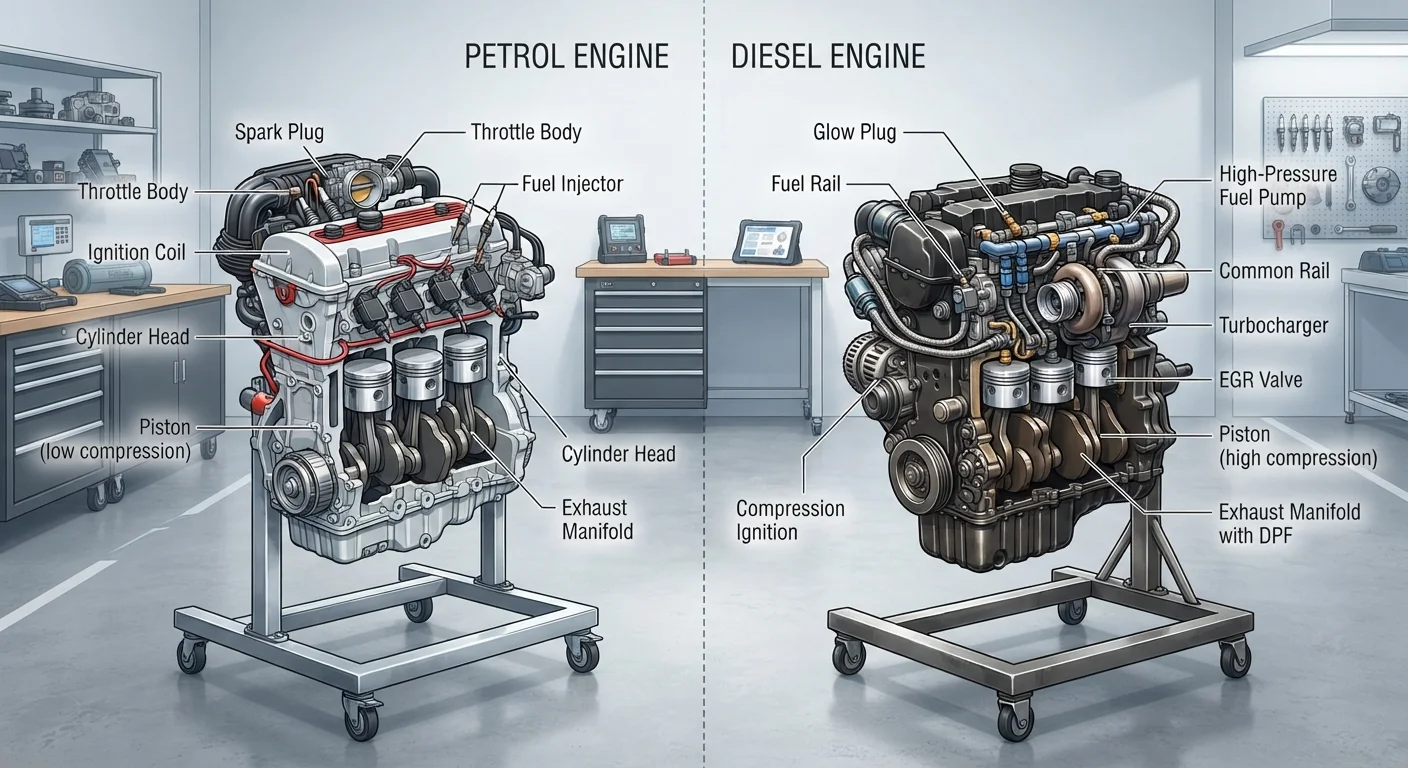
How Each Engine Type Works — The Short Version
Both petrol and diesel engines are internal combustion engines, meaning they burn fuel inside cylinders to generate power. The core difference is how ignition happens. A petrol engine uses spark plugs to ignite a fuel-air mixture. A diesel engine relies on compression alone — diesel fuel ignites when highly compressed air raises its temperature enough to trigger combustion without a spark.
This mechanical difference has real-world consequences. Diesel engines operate at higher compression ratios, which is why they produce more torque (rotational pulling force) at lower engine speeds. Petrol engines rev more freely and respond quickly to throttle input, which suits urban driving. For a deeper look at all four powertrain categories, see what each powertrain actually means.
| Criterion | Petrol (Gasoline) | Diesel |
|---|---|---|
| Ignition method | Spark plug ignition | Compression ignition |
| Torque delivery | Higher RPM, responsive | High torque at low RPM |
| City driving efficiency | Well suited | Less efficient; DPF risk |
| Highway driving efficiency | Adequate | Notably more efficient |
| Typical upfront cost | Generally lower | Generally higher |
| Fuel availability (US) | Widely available | Less universally available |
| Towing capability | Capable, varies by model | Strong low-end pull |
| Maintenance complexity | Broad service network | Specialized components (DPF) |
| Emissions regulations (US) | Standard compliance | Stricter in some states |
Driving Pattern: The Deciding Factor
Fuel type is not a lifestyle choice — it's an engineering match to driving behavior. Petrol engines are optimized for variable driving: accelerating, decelerating, and idling. Diesel engines reach peak efficiency under steady-state conditions, particularly at highway speeds where the engine can maintain a consistent load.
A diesel vehicle driven exclusively on short city runs will rarely reach its ideal operating temperature. This can lead to a condition known as diesel particulate filter (DPF) clogging — a costly problem caused by incomplete combustion residue accumulating in the exhaust filter. Petrol engines don't carry this concern. Conversely, a petrol engine covering 30,000 highway miles per year will consume noticeably more fuel than a diesel doing the same distance.
~25–30%
Diesel's highway fuel efficiency advantage
Diesel fuel contains roughly 10–15% more energy per gallon than gasoline, and diesel engines convert that energy more efficiently, particularly at steady highway speeds.
~3%
Share of US passenger vehicles that are diesel
Diesel passenger cars represent a small fraction of the US market, where gasoline and, increasingly, hybrid and electric vehicles dominate consumer sales.
10–15%
Typical diesel vehicle price premium
Diesel-equipped models often carry a price premium over comparable gasoline variants, a gap buyers need to offset through fuel savings over time.
If your annual mileage is heavily weighted toward highway driving, the comparison shifts further. See how powertrains compare on long-distance drives for a practical breakdown.
Cost Considerations Beyond the Pump
Fuel efficiency is only part of the cost equation. Diesel vehicles typically carry a higher sticker price than equivalent petrol models. Diesel fuel itself can be priced higher or lower than gasoline depending on market conditions and region — it's not consistently cheaper at US pumps. Maintenance costs also differ: diesel engines are generally durable and can achieve high mileage when properly serviced, but specialized components like the DPF and high-pressure fuel injection systems can be expensive to repair.
Petrol vehicles benefit from a wider service network and lower parts costs in most US markets. Registration fees and emissions-related costs may also apply differently. Some US states — notably California — impose stricter emissions standards that effectively limit diesel passenger vehicle availability. Before committing, check your state's regulatory environment.
State Emissions Rules Can Limit Diesel Options
California and several states that adopt its emissions standards apply stricter limits on diesel passenger vehicles, which can affect which models are available for purchase. If you live in one of these states, check current regulations before targeting a diesel vehicle. Requirements evolve, and what's available in Texas may not be offered in California. Your state's department of motor vehicles or air resources board is the authoritative source.
Want a structured way to think through total cost of ownership? Work through the key questions before choosing a powertrain.
Petrol vs Diesel: Where Each One Pulls Ahead
Neither fuel type is universally superior. Petrol suits the majority of US drivers whose primary use is urban or suburban commuting, occasional road trips, and general-purpose daily driving. Diesel earns its advantage in specific, high-mileage or high-load scenarios.
Drivers curious about alternatives — particularly for high annual mileage — should note that the diesel-vs-hybrid calculus has shifted in recent years. See how hybrid and diesel now compare for high-mileage drivers for a current perspective. Hybrid options are explored further at the hybrid options hub.
For a complete picture of all powertrain types available to US buyers, the complete powertrain guide for car buyers covers everything in one place.