
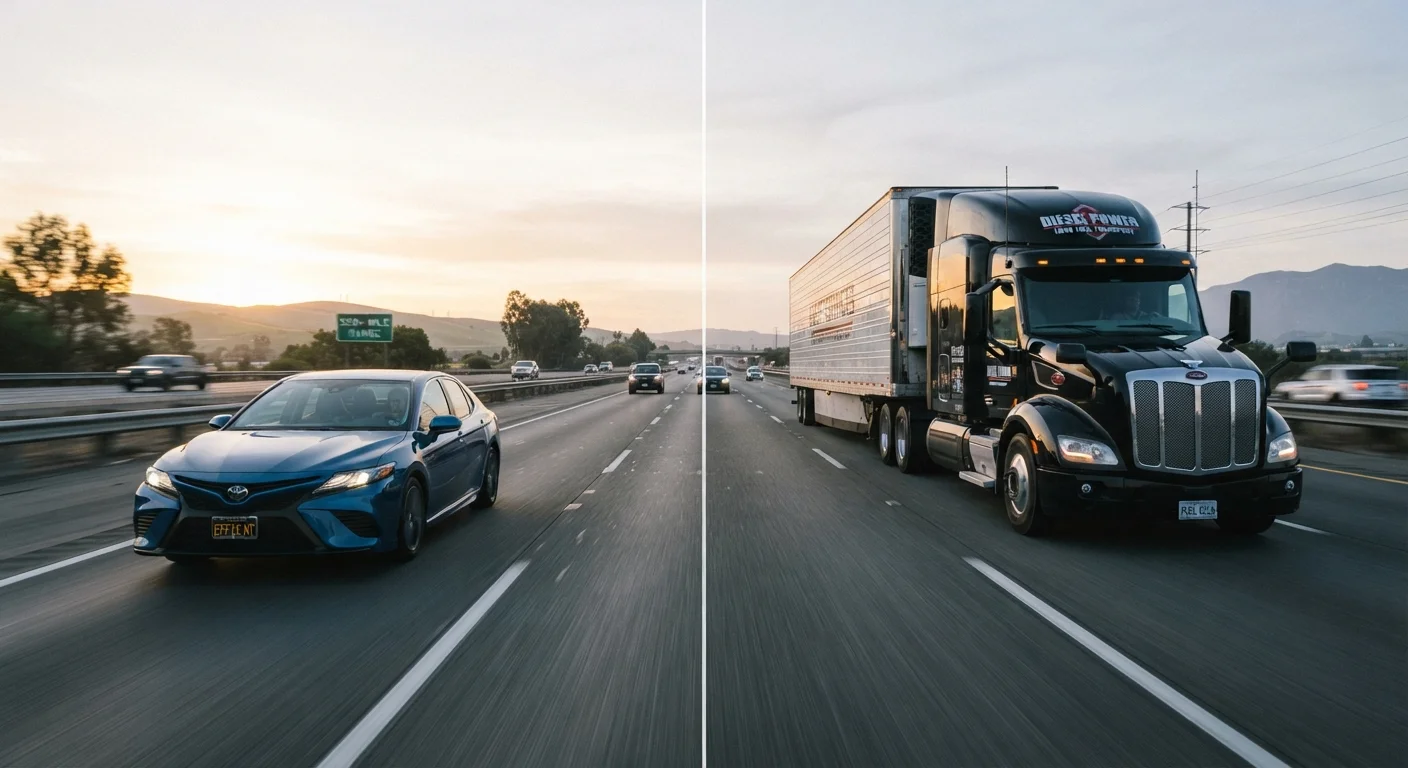
Why High Mileage Changes the Equation
For decades, high-mileage drivers in the U.S. were advised to look at diesel. The logic was straightforward: diesel engines are thermally efficient, particularly on long highway runs, and their higher fuel economy could offset a steeper purchase price over many miles. That arithmetic still holds in certain scenarios — but it no longer tells the whole story.
The hybrid powertrain landscape has matured considerably. Conventional hybrids (also called self-charging hybrids) use a gasoline engine paired with an electric motor and a small battery that recharges through regenerative braking — no plugging in required. For drivers covering 20,000–30,000 miles annually, the compounding effect of fuel savings and lower maintenance expenses is now genuinely competitive with diesel across many use profiles.
The key is understanding that neither powertrain is universally superior. Efficiency depends heavily on where those miles are driven. See our practical look at powertrain types and long-distance driving for a broader breakdown of how each drivetrain performs on extended trips.
Efficiency: Where Each Powertrain Actually Shines
Hybrid efficiency is highest in conditions that involve frequent acceleration and deceleration — city streets, suburban commutes, and congested highways. Regenerative braking converts kinetic energy back into electricity, meaning energy that a conventional engine wastes as heat is partially recovered. EPA combined fuel economy figures for many hybrid sedans and crossovers range from the low-to-mid 40s MPG up to the high 50s for some models.
Diesel efficiency works differently. At a steady 65–70 mph cruise, a diesel engine operates near its thermodynamic sweet spot, extracting more energy per gallon than a gasoline engine and with minimal opportunity for hybrid regeneration to compensate. EPA highway figures for diesel passenger vehicles commonly land in the 35–45 MPG range depending on vehicle class, and real-world results often exceed EPA estimates on pure highway runs.
The crossover point: if your driving is predominantly highway at consistent speeds, diesel's efficiency advantage remains real. If your high mileage is mixed or urban-heavy, hybrid efficiency erodes diesel's edge substantially — and often reverses it.
| Criterion | Hybrid (Conventional) | Diesel |
|---|---|---|
| City/mixed MPG | Strong — regeneration helps most | Moderate — less efficient in traffic |
| Highway MPG | Good, but edge narrows vs. diesel | Strong — peak thermal efficiency |
| Fuel type required | Regular gasoline only | Diesel + DEF fluid |
| Emissions-related maintenance | Minimal — no DPF or SCR | DPF, SCR, DEF refills required |
| Towing capability | Limited in most configurations | High torque suits towing well |
| Regulatory risk (urban use) | Low — no known U.S. restrictions | Higher — zone restrictions emerging |
| Battery / engine longevity | Proven in high-mileage fleet data | Durable engines; DPF wear a variable |
| Purchase price premium | Moderate over gasoline equivalent | Moderate-to-high over gasoline |
True Cost of Ownership: Beyond the Sticker and the Pump
Fuel cost per mile is only one variable. High-mileage drivers need to account for several additional factors before reaching a conclusion.
- Diesel exhaust fluid (DEF): Modern diesel vehicles equipped with selective catalytic reduction (SCR) systems require DEF — a urea-based fluid — in addition to fuel. Consumption is roughly 2–3% of fuel volume, adding a modest but real ongoing cost and a refill task.
- Diesel particulate filter (DPF) maintenance: DPFs trap soot and require periodic regeneration cycles. In primarily short-trip or city driving, incomplete regeneration can lead to costly repairs. This is a known risk for urban diesel use.
- Hybrid battery longevity: Contemporary hybrid battery packs from major manufacturers are warranted for 8 years / 100,000 miles federally (and longer in California-standard states). Real-world data from taxi fleets and high-mileage owners suggests many packs endure well beyond warranty periods with modest degradation.
- Fuel price differential: Diesel prices relative to regular gasoline fluctuate by region and season. When diesel commands a significant premium, its efficiency advantage narrows in cost-per-mile terms.
For a balanced look at the hybrid side of this ledger, our honest trade-offs of going hybrid covers both the genuine benefits and the real limitations in detail.
8 yrs / 100K mi
Federal hybrid battery warranty minimum
U.S. federal law requires automakers to warrant hybrid and EV battery packs for at least 8 years or 100,000 miles, whichever comes first.
2–3%
DEF consumption as share of diesel fuel volume
Most modern diesel vehicles with SCR systems consume diesel exhaust fluid at roughly 2–3% of their diesel fuel consumption rate, per manufacturer specifications.
~$0.02–0.05
Typical DEF cost per mile (estimated)
Based on average DEF retail pricing and typical diesel fuel economy, DEF adds an estimated 2–5 cents per mile to diesel running costs, varying by region and consumption rate.
Emissions Regulations and Future Ownership Risk
High-mileage drivers tend to keep vehicles longer, which makes regulatory risk a legitimate ownership consideration — not just an abstract concern.
Diesel vehicles face a more complex regulatory environment than hybrids. Several major U.S. cities and municipalities have considered or implemented restrictions on older diesel vehicles in certain zones, and international precedents (notably in Europe) show that diesel ownership costs can increase sharply when emission zone rules tighten. Our article on diesel in a post-emissions era explains what current U.S. emissions standards mean for diesel buyers today.
Hybrids, by contrast, produce lower NOx and particulate emissions than diesel and face no comparable regulatory headwinds in the U.S. market. If you plan to own a vehicle for eight or more years and drive in or near urban centers, this asymmetry in regulatory risk deserves weight in your decision.
It is also worth noting that if you are evaluating a plug-in hybrid (PHEV) as an alternative, the architecture and trade-offs differ meaningfully from a conventional hybrid. Our hybrid vs. plug-in hybrid comparison walks through those differences side by side.
Hybrid Types Matter: Conventional vs. PHEV
This article focuses on conventional (self-charging) hybrids, which do not require plugging in. Plug-in hybrids (PHEVs) have larger batteries, can run on electricity for short distances, and carry a different cost and efficiency profile. If you are considering a PHEV, treat it as a distinct category with its own trade-offs rather than a direct substitute for the conventional hybrid discussed here.
Making the Call for Your Driving Profile
No single answer fits every high-mileage driver. The most productive approach is to map your actual driving pattern before evaluating specs or pricing.
- Estimate your city-to-highway ratio. If more than 60% of your miles occur in stop-and-go or mixed conditions, hybrid efficiency is likely to outperform diesel in your real-world use.
- Calculate fuel cost per mile for both options using current local fuel prices and realistic — not best-case — MPG figures from EPA estimates or owner-reported data.
- Factor in ownership duration. The longer you plan to keep the vehicle, the more important battery longevity (for hybrids) and emissions compliance (for diesel) become.
- Consider your maintenance access. DEF availability and qualified diesel technicians are less uniformly distributed than general hybrid service, particularly in rural areas.
For drivers weighing a full electric vehicle instead, our hybrid vs. electric comparison covers the range, charging, and cost trade-offs in detail. And if the new-versus-used question applies to your search, the new vs. used cars hub is a useful starting point for understanding that separate set of trade-offs.
This article provides general educational information about vehicle powertrains and is not a substitute for independent research, professional mechanical advice, or personalised financial guidance. Fuel economy, maintenance costs, and regulatory conditions vary by vehicle, region, and individual use.