
Why Depreciation Is the Cost Buyers Most Often Overlook
When most buyers compare new versus used, they focus on sticker price, monthly payments, and fuel economy. Depreciation rarely shows up on a window sticker — but it's typically the single largest cost of owning a vehicle, often exceeding what you'll spend on fuel or maintenance over the same period.
Unlike a repair bill, depreciation doesn't arrive as an invoice. It accumulates silently, and you only see its full effect when you go to sell or trade in. For anyone making a serious new-versus-used decision, understanding how depreciation works — and when it hits hardest — is essential groundwork.
See our overview of how depreciation shapes the new vs. used decision for a broader look at where this factor fits in the full buying picture.
~20%
Typical new car value lost in year one
Industry estimates consistently place first-year depreciation between 15% and 25% for most mainstream vehicles, though rates vary by segment and demand.
~50%
Value lost by year five for many vehicles
Automotive valuation analysts broadly estimate that a typical car retains roughly half its original value after five years, though high-demand categories like trucks often hold value better.
3 years
Point where depreciation curve begins to flatten noticeably
After the initial steep drop, most vehicles settle into a slower, more gradual rate of value loss — making the 3-to-5-year-old window a commonly cited sweet spot for used car value.
The Depreciation Curve: Front-Loaded and Predictable
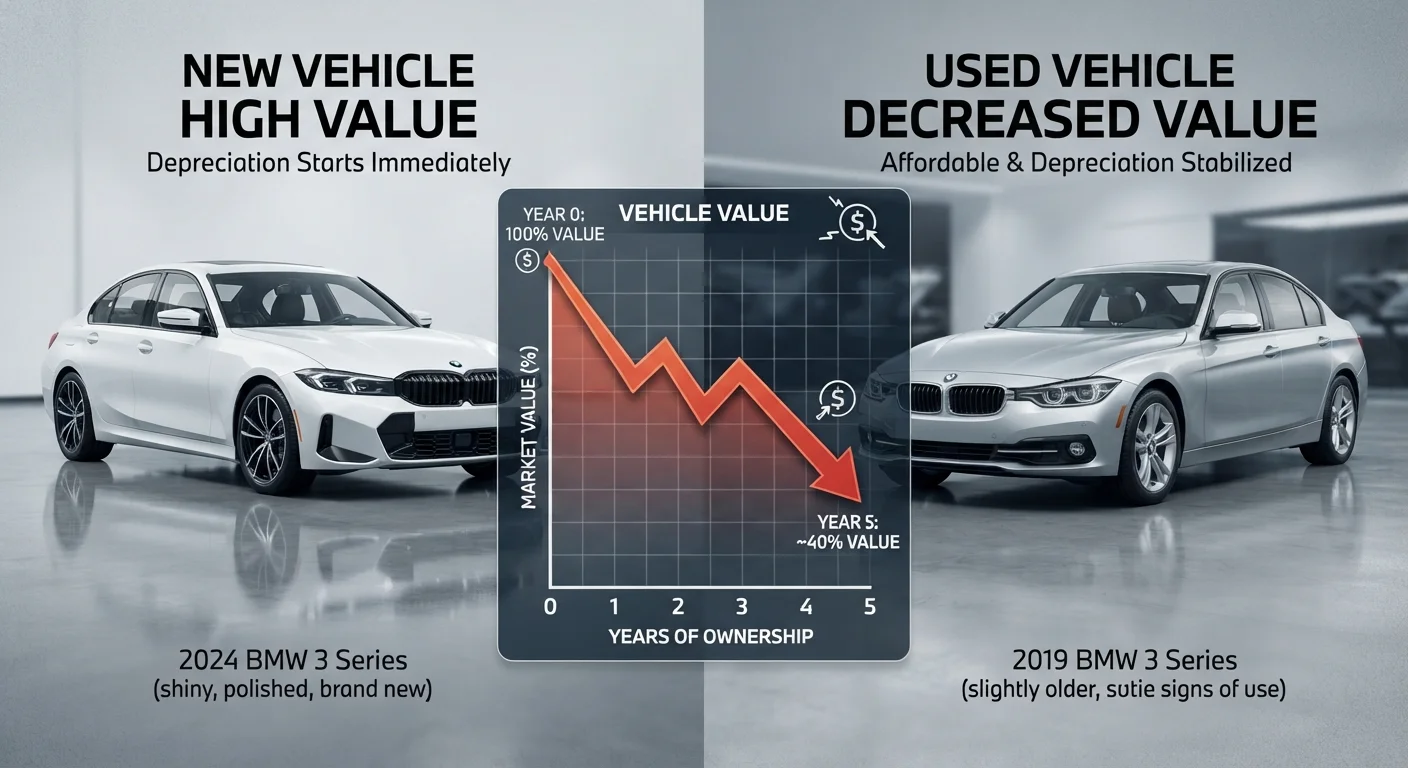
Depreciation doesn't erode value at a steady pace. It follows a curve that's steep at the start and flattens over time. A typical vehicle might lose 15–25% of its value in year one, another 10–15% in year two, and progressively smaller percentages in subsequent years. By year five, many vehicles have lost 40–60% of their original value.
This front-loaded pattern has a direct implication for buyers: the person who purchases a new car absorbs the sharpest drop. The buyer who picks up that same car at two or three years old steps onto a much flatter section of the curve.
For a detailed year-by-year breakdown, see what actually happens to a car's value over 10 years.
“Depreciation is the largest single cost of car ownership for most drivers — larger than fuel, larger than insurance, and largely invisible until the moment you try to sell.”
— Consumer automotive research consensus, Reflected across independent vehicle cost-of-ownership analyses
New vs. Used: What Depreciation Actually Means for Your Wallet
Buying new means you're paying for a car at peak value and absorbing its largest value drop yourself. That's not inherently wrong — new cars come with full warranties, the latest safety technology, and no ownership history to scrutinize. But the financial cost of that first-year drop is real and should be factored into any honest comparison.
Buying used means someone else has already taken that hit. A three-year-old vehicle may have shed $8,000–$12,000 or more in value since it left the lot — value that the original buyer lost but that you, as the second owner, don't pay for. Your depreciation exposure going forward is also considerably lower on an annual basis.
That said, used cars carry their own financial considerations: potentially higher financing rates, shorter remaining warranty coverage, and the possibility of deferred maintenance. A full cost-of-ownership comparison between new and used requires factoring in all of these variables, not just the purchase price.
Run the Numbers Before You Decide
Before committing to new or used, look up the current private-party resale value of the new model you're considering at three and five years old. That range gives you a concrete estimate of the depreciation you'd absorb as a new buyer — and helps you compare it honestly against a used purchase at that same age.
How to Use Depreciation Data in Your Own Decision
Understanding the concept is useful; applying it is what matters. A few practical points worth keeping in mind:
- Calculate total cost, not just price: Estimate the likely resale value at the point you'd sell, then subtract it from your total purchase and ownership costs. That gap is your true cost of ownership.
- Consider your ownership timeline: If you hold a vehicle for 10 years, the new-versus-used depreciation gap shrinks significantly — both cars will be deeply depreciated. If you plan to sell in three to four years, buying used often makes more financial sense.
- Watch for being underwater on a loan: If a new vehicle depreciates faster than your loan balance falls, you may owe more than the car is worth — a situation called negative equity. This is general information, not personalised financial advice; a qualified financial adviser can help you assess your specific situation.
For more on how depreciation affects used car timing specifically, see depreciation and the used car buyer.
This article provides general automotive and financial information for educational purposes only. It is not personalised financial or investment advice. Readers should consult a qualified financial adviser before making decisions specific to their circumstances.